(no subject)
20/1/11 18:05![[identity profile]](https://www.dreamwidth.org/img/silk/identity/openid.png) malasadas.livejournal.com posting in
malasadas.livejournal.com posting in ![[community profile]](https://www.dreamwidth.org/img/silk/identity/community.png) talkpolitics
talkpoliticsPresident Obama is preparing to give his 3rd State of the Union Address on Tuesday, January 25th. As he does so, he faces a new Congress with a Republican majority in the House that has already voted to repeal the administration's signature legislative accomplishment. Unemployment has remained well above 9% since July of 2009, and the economic recovery has many voters and analysts rethinking the meaning of the word "recovery". The President's approval rating have taken a beating since he assumed his office, and there have been many in the punditry who have assumed that the President has been irreversibly damaged by the political outcomes of the past year.
I cannot help, old fart that I am, but to be reminded of another holder of the office who was in fairly dire straights in the first half of his term in office. This President faced a recession not of his own making, high unemployment, lowering approval ratings and his party faced serious setbacks in Congress in his first midterm election.
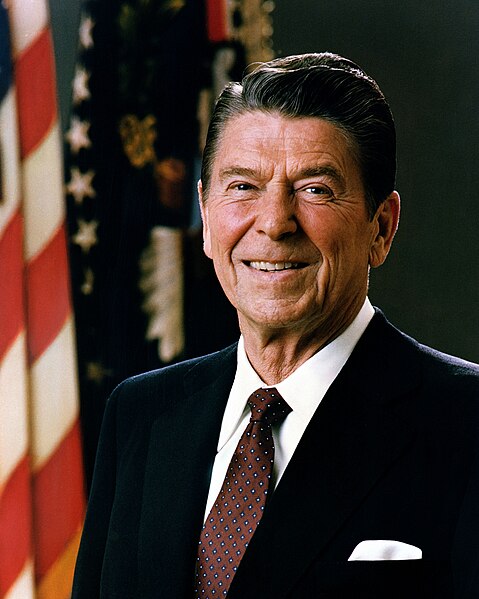
Ronald Wilson Reagan -- 40th President of the United States of America
Now, obviously, that comparison doesn't hold in so far as the two Presidents are not pursuing the same agendas, and given the courtesy of distance and history, both scholars and partisans can either analyze or advocate President Reagan's accomplishments and contributions to American history, society and culture.
But I also think it is very important to recognize the President Ronald Reagan who held office (and whose 100th birthday is about to be recognized on February 6th of the this year) is not precisely the President Ronald Reagan of political mythology that his various admirers and partisans have elevated in the years since he left office. THAT President Reagan is offered to us as an unflinching champion of conservatism who upheld principle above all else, who single handedly rescued us from both economic malaise and international communism and who deserved to have his name attached to practically every project in federal reach even before his death in 2004.
The Ronald Reagan who held the office of President of the United States from January 1981 to January 1989 was a far more mortal figure. In his time, he was criticized and sometimes ridiculed:


When the President testified to the Tower Commission about the Iran/Contra affair and offered testimony that struck most observers as confused and befuddled and when after leaving office he testified again for the trial of John Poindexter and had trouble remembering names of members of his national security team, many of his political opponents took this as confirmation that the President's Alzheimer's disease had set in prior to the end of his administration. In fact, many of us sort of hoped that Phil Hartman's portrayal of the President was secretly correct:
Now, obviously, there will be plenty of people who did not and do not agree with these perceptions of President Reagan, but suffice it to say that his post-administration idolization is not reflective of how the entire public saw his Presidency, especially in his first two years.
It is true that Ronald Reagan entered the office at a time of deep economic discontent. The recession of the early 1980s was deep and difficult. In 1980, inflation was at 13.5%. The Federal Reserve jacked interest rates to 20% by June of 1981. The unemployment rate was 7.5% when Reagan took office and rose to 10.8% in December of 1982 and stayed above 10% through June of 1983. President Reagan's approval ratings took a sharp hit, dipping as low as 35% in January, 1983.
We, of course, know that this was not the end of the line for the Reagan Presidency. By 1983, the Federal Reserve's contractionary monetary policy had brought inflation down to 3.2%, and loosening the money policy helped reverse the recession. Joblessness fell to 7.2% by election day in 1984 and President Reagan won his landslide victory.
As a side note -- if you are even trying to argue with someone that President Obama was handed one of the biggest economic messes in modern history and are met with a persona responding by screaming BUT BUT BUT BUSH (a reply to critiques of Bush that I first heard from conservative bloggers when President Bush still had more than 6 months left in his term), it is worth noting that President Reagan's reelection theme was "It's Morning in America" -- meaning, "Carter screwed things up so bad, it finally took us 4 years to fix it"....
The President Reagan of reality doesn't match the President Reagan of myth in other ways as well. Ronald Reagan may have cut top marginal tax rates from their admittedly dizzying heights -- he also passed bills and made deals that effectively increased the federal governments tax reach (while leaving income taxes alone). Reagan the stalwart who did not waiver in the face of our enemies -- withdrew American forces from Beirut 4 months after pledging that Americans would stay in Beirut after the 1983 barracks bombing. And to be fair -- to contrast a liberal perception of Reagan as a died in the wool war monger who never saw a weapons system he did not embrance -- that same Ronald Reagan negotiated the Intermediate Range Forces Treaty with the USSR, a treaty that permanently banned an entire class of nuclear ballistic missile.
I'd be remiss if I did not mention that I think President Reagan had some advantages over President Obama regardless of what you think of either the ideas of or the political skills of either man:
First, Reagan had Paul Volcker. While I mentioned that the Fed had set off a steep recession with interest rates, it should be noted that this was done to put an end to the stagflation crisis of the 1970s. Using Milton Friedman's monetary theory of inflation Volcker put enormous pain on the economy to kill inflation, and when he finally took his foot off the brake, there was plenty of room for the economy to expand.
President Obama has an economy trying to recover from a very different kind of crisis, one that usually takes years to see real gains in employment under the best of circumstances. Further, Obama's Fed Chair simply doesn't have the tools Volcker could deploy -- interest rates have been historically low for years, and the Fed is more concerned about deflation than inflation. On the other hand, while Washington, D.C. figures have railed about $800 billion in fiscal stimulus spread over two years, the Fed has used monetary policy to add about another 2 trillion to the economy even before setting off another round of controversy with the recent "quantitative easing" plan.
Second, Ronald Reagan had Tip O'Neill. These two men may have been partisan politicians, but they also were of a generation of Washington politicians who could fight like hell on the Hill and then go out for a beer afterward. Reagan and O'Neill famously worked together in 1983 on a plan that kept Social Security solvent.
We will see what President Obama has in Speaker of the House John Boehner, but I think we already know what he has in Senate Minority Leader Mitch McConnell. Approve or disapprove of how he has run the minority caucus, it is not disputable that Senator McConnell has managed to use the Senate's procedural rules not simply to slow down controversial bills and appointees but to reduce the pace of everything to a crawl, and, despite his protestations to wanting to work with the President, he has done so from day one.
Finally, Ronald Reagan had a very different media environment. There was no internet, so that day's "bloggers" had to use far less effective methods like pamphlets and fliers. CNN was founded in 1980, so there the 24 hour a days news business was in its very infancy. The typical news model was a morning news report at breakfast, a short noon update and the evening news -- instead of today's environment that requires a constant stream of content that rarely gets vetted before going on air. I won't pretend that it was a glorious age of objective journalism -- but what it was was a much easier news environment to understand. And Reagan was exceptionally skilled at using media for communication in an age when he was not immediately pounced upon by 1000 voices ranging from sensible opposition to absolutely batshit crazy.
With all of that in mind, the lesson is that Presidencies are deemed successful or failures far too prematurely -- and often based upon hindsight that is far from 20/20. Do you see potential for the second half of President Obama's first term to teach us a similar lesson?
I cannot help, old fart that I am, but to be reminded of another holder of the office who was in fairly dire straights in the first half of his term in office. This President faced a recession not of his own making, high unemployment, lowering approval ratings and his party faced serious setbacks in Congress in his first midterm election.
Ronald Wilson Reagan -- 40th President of the United States of America
Now, obviously, that comparison doesn't hold in so far as the two Presidents are not pursuing the same agendas, and given the courtesy of distance and history, both scholars and partisans can either analyze or advocate President Reagan's accomplishments and contributions to American history, society and culture.
But I also think it is very important to recognize the President Ronald Reagan who held office (and whose 100th birthday is about to be recognized on February 6th of the this year) is not precisely the President Ronald Reagan of political mythology that his various admirers and partisans have elevated in the years since he left office. THAT President Reagan is offered to us as an unflinching champion of conservatism who upheld principle above all else, who single handedly rescued us from both economic malaise and international communism and who deserved to have his name attached to practically every project in federal reach even before his death in 2004.
The Ronald Reagan who held the office of President of the United States from January 1981 to January 1989 was a far more mortal figure. In his time, he was criticized and sometimes ridiculed:
When the President testified to the Tower Commission about the Iran/Contra affair and offered testimony that struck most observers as confused and befuddled and when after leaving office he testified again for the trial of John Poindexter and had trouble remembering names of members of his national security team, many of his political opponents took this as confirmation that the President's Alzheimer's disease had set in prior to the end of his administration. In fact, many of us sort of hoped that Phil Hartman's portrayal of the President was secretly correct:
Now, obviously, there will be plenty of people who did not and do not agree with these perceptions of President Reagan, but suffice it to say that his post-administration idolization is not reflective of how the entire public saw his Presidency, especially in his first two years.
It is true that Ronald Reagan entered the office at a time of deep economic discontent. The recession of the early 1980s was deep and difficult. In 1980, inflation was at 13.5%. The Federal Reserve jacked interest rates to 20% by June of 1981. The unemployment rate was 7.5% when Reagan took office and rose to 10.8% in December of 1982 and stayed above 10% through June of 1983. President Reagan's approval ratings took a sharp hit, dipping as low as 35% in January, 1983.
We, of course, know that this was not the end of the line for the Reagan Presidency. By 1983, the Federal Reserve's contractionary monetary policy had brought inflation down to 3.2%, and loosening the money policy helped reverse the recession. Joblessness fell to 7.2% by election day in 1984 and President Reagan won his landslide victory.
As a side note -- if you are even trying to argue with someone that President Obama was handed one of the biggest economic messes in modern history and are met with a persona responding by screaming BUT BUT BUT BUSH (a reply to critiques of Bush that I first heard from conservative bloggers when President Bush still had more than 6 months left in his term), it is worth noting that President Reagan's reelection theme was "It's Morning in America" -- meaning, "Carter screwed things up so bad, it finally took us 4 years to fix it"....
The President Reagan of reality doesn't match the President Reagan of myth in other ways as well. Ronald Reagan may have cut top marginal tax rates from their admittedly dizzying heights -- he also passed bills and made deals that effectively increased the federal governments tax reach (while leaving income taxes alone). Reagan the stalwart who did not waiver in the face of our enemies -- withdrew American forces from Beirut 4 months after pledging that Americans would stay in Beirut after the 1983 barracks bombing. And to be fair -- to contrast a liberal perception of Reagan as a died in the wool war monger who never saw a weapons system he did not embrance -- that same Ronald Reagan negotiated the Intermediate Range Forces Treaty with the USSR, a treaty that permanently banned an entire class of nuclear ballistic missile.
I'd be remiss if I did not mention that I think President Reagan had some advantages over President Obama regardless of what you think of either the ideas of or the political skills of either man:
First, Reagan had Paul Volcker. While I mentioned that the Fed had set off a steep recession with interest rates, it should be noted that this was done to put an end to the stagflation crisis of the 1970s. Using Milton Friedman's monetary theory of inflation Volcker put enormous pain on the economy to kill inflation, and when he finally took his foot off the brake, there was plenty of room for the economy to expand.
President Obama has an economy trying to recover from a very different kind of crisis, one that usually takes years to see real gains in employment under the best of circumstances. Further, Obama's Fed Chair simply doesn't have the tools Volcker could deploy -- interest rates have been historically low for years, and the Fed is more concerned about deflation than inflation. On the other hand, while Washington, D.C. figures have railed about $800 billion in fiscal stimulus spread over two years, the Fed has used monetary policy to add about another 2 trillion to the economy even before setting off another round of controversy with the recent "quantitative easing" plan.
Second, Ronald Reagan had Tip O'Neill. These two men may have been partisan politicians, but they also were of a generation of Washington politicians who could fight like hell on the Hill and then go out for a beer afterward. Reagan and O'Neill famously worked together in 1983 on a plan that kept Social Security solvent.
We will see what President Obama has in Speaker of the House John Boehner, but I think we already know what he has in Senate Minority Leader Mitch McConnell. Approve or disapprove of how he has run the minority caucus, it is not disputable that Senator McConnell has managed to use the Senate's procedural rules not simply to slow down controversial bills and appointees but to reduce the pace of everything to a crawl, and, despite his protestations to wanting to work with the President, he has done so from day one.
Finally, Ronald Reagan had a very different media environment. There was no internet, so that day's "bloggers" had to use far less effective methods like pamphlets and fliers. CNN was founded in 1980, so there the 24 hour a days news business was in its very infancy. The typical news model was a morning news report at breakfast, a short noon update and the evening news -- instead of today's environment that requires a constant stream of content that rarely gets vetted before going on air. I won't pretend that it was a glorious age of objective journalism -- but what it was was a much easier news environment to understand. And Reagan was exceptionally skilled at using media for communication in an age when he was not immediately pounced upon by 1000 voices ranging from sensible opposition to absolutely batshit crazy.
With all of that in mind, the lesson is that Presidencies are deemed successful or failures far too prematurely -- and often based upon hindsight that is far from 20/20. Do you see potential for the second half of President Obama's first term to teach us a similar lesson?


(no subject)
Date: 20/1/11 23:17 (UTC)(no subject)
Date: 21/1/11 00:51 (UTC)And then there's the visit...
Date: 21/1/11 01:45 (UTC)Re: And then there's the visit...
Date: 21/1/11 14:06 (UTC)Re: And then there's the visit...
Date: 21/1/11 14:07 (UTC)I know nationalism is generally frowned upon but...
Date: 20/1/11 23:37 (UTC)I always enjoy your bloom county posts.
Re: I know nationalism is generally frowned upon but...
Date: 21/1/11 00:03 (UTC)And thanks :-)
Re: I know nationalism is generally frowned upon but...
Date: 21/1/11 00:29 (UTC)those are good too though.
Re: I know nationalism is generally frowned upon but...
Date: 21/1/11 00:39 (UTC)(no subject)
Date: 20/1/11 23:53 (UTC)(no subject)
Date: 21/1/11 00:04 (UTC)(no subject)
Date: 21/1/11 06:15 (UTC)(no subject)
Date: 21/1/11 18:32 (UTC)Sir, No Sir! (http://www.sirnosir.com/) documents her story a bit.
(no subject)
Date: 21/1/11 00:11 (UTC)(no subject)
Date: 21/1/11 00:30 (UTC)Besides, people's idea of Alzheimer's tends to be solely based on the endgame - it's amazing how completely functional sufferers are for quite a while.
(no subject)
Date: 21/1/11 00:57 (UTC)(no subject)
Date: 21/1/11 01:05 (UTC)(no subject)
Date: 21/1/11 01:11 (UTC)And I'm sorry -- that is never an easy thing to deal with as a loved one. I wouldn't wish Reagan's last years on anyone -- or on anyone's family.
(no subject)
Date: 21/1/11 01:33 (UTC)(no subject)
Date: 21/1/11 05:26 (UTC)(no subject)
Date: 21/1/11 02:26 (UTC)Well he certainly said things happened that seemingly run counter to actual documented historical fact.
(no subject)
Date: 21/1/11 02:28 (UTC)(no subject)
Date: 21/1/11 02:33 (UTC)All I've had time to do is roll my eyes at the inane chatter as of late.
(no subject)
Date: 21/1/11 01:07 (UTC)(no subject)
Date: 21/1/11 01:09 (UTC)(no subject)
Date: 21/1/11 00:29 (UTC)(no subject)
Date: 21/1/11 00:39 (UTC)And I don't articulate it well here, but I'm not going for a comparison of personal qualities or ideas -- I'm intrigued by the circumstances that are either mostly or at least partially outside of the respective Presidents' control.
(no subject)
Date: 21/1/11 01:04 (UTC)(no subject)
Date: 21/1/11 00:49 (UTC)(no subject)
Date: 21/1/11 00:56 (UTC)(no subject)
Date: 21/1/11 01:10 (UTC)Do you remember...
Date: 21/1/11 01:51 (UTC)The Reagan legacy: MS-13 and the Taliban.
Re: Do you remember...
Date: 21/1/11 14:08 (UTC)Re: Do you remember...
Date: 23/1/11 00:10 (UTC)(no subject)
Date: 21/1/11 05:07 (UTC)One of my favorites...
Date: 23/1/11 00:12 (UTC)The Reagan era was the time of, "Mistakes were made."
(no subject)
Date: 21/1/11 07:37 (UTC)(no subject)
Date: 21/1/11 14:59 (UTC)(no subject)
Date: 21/1/11 19:01 (UTC)(no subject)
Date: 22/1/11 00:18 (UTC)For Reagan the third year of his term was one of unending good economic news, including growth rates of 8%. We are nowhere near that point this time around.
Even the Fed is running against history, continuing to flood the market with money when post-1980 consensus was to reign in the "velocity" of money.
As for the Social Security "fix", that's not something I'd point to as an achievement. It was sold as a permanent fix and as we have seen was merely another attempt to push the day of reckoning past the retirement age of current politicians.
As for Beruit, Reagan pulled the troops out when their presence (no matter how ill-advised) was no longer needed. Without them Israel and Syria probably would have gone to war.
(no subject)
Date: 22/1/11 02:01 (UTC)The Beirut pull out was a mere 4 months after Reagan had vowed we'd stay -- it was an INCREASE in terrorist attacks that finally got the administration to cut its losses and leave.