Dragon goes to Africa
25/7/17 13:13![[personal profile]](https://www.dreamwidth.org/img/silk/identity/user.png) abomvubuso posting in
abomvubuso posting in ![[community profile]](https://www.dreamwidth.org/img/silk/identity/community.png) talkpolitics
talkpolitics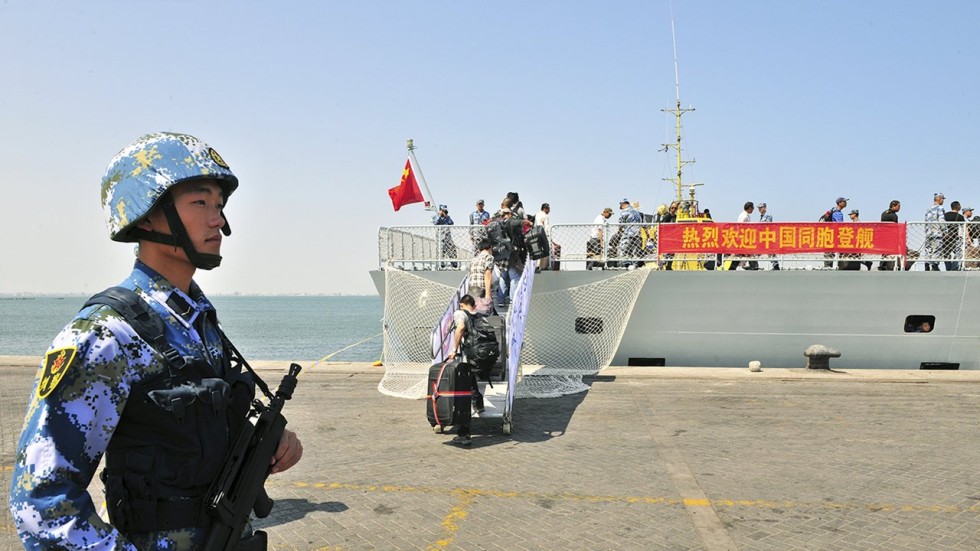
Dressed in neat military uniforms, sailing in hi-tech amphibious vehicles. That's how the troops of the first battalion China has sent overseas in 60 years look like. The unit will be sent to the new military base in Djibouti, on the east coast of Africa, just opposite Saudi Arabia across the Bay of Aden. The place is chosen deliberately of course, it's just next door to war-torn regions like Somalia, Ethiopia and Eritrea, in a corner of huge strategic importance.
This mission shows just how much the Chinese have intensified their presence on this continent, which drastically contrasts to their non-intervention tradition that they've kept elsewhere. Since Xi Jinping came to power in 2012, China has abruptly changed its foreign policy in a bid to boost their economic standing and their access to crucial resources around the world.
For decades, China has insisted that they're different from other military superpowers because they never had a military base on foreign territory. But now they may've realised that defending their interests spreads way beyond their backyard, and in order to keep in pace with the other big players, they'd need to have an efficient military that would be pro-active, and capable of responding to any emerging situations.
So the troops they're sending to Djibouti are doing exactly that, defending China's interests in that region, mainly against US infringement, but also countering other potential competitors as well. The new military base will give China a strategic advantage in a zone that's typically perceived as America's domain. Now that China has established a big economic presence in Africa, they're also taking the next step, and backing it up with strong military presence in a key passage between the seas, where the US and France have long maintained bases of their own. Basically, there's a new player on the board now.
Indeed, China's interests at the international scene have grown along with their overseas investments. Between 2002-2017, their size skyrocketed from $2.7 bn to 170 bn. In the recent couple of years, beside the military base and a number of military and peace-keeping units (the Chinese UN mission in South Sudan alone numbers 750 personnel, and their Blue Helmet presence in Africa is now well over 2,000), Xi Jinping has also hugely boosted the Chinese control of the South China Sea. Unlike the peace-keeping forces that seldom use arms and often constitute just engineers and cops, the Chinese troops in Djibouti will be fully armed and prepared for military action.
Unlike the US (whose previous president, true to the established practice, used to personally vouch and lobby on behalf of US corporations wherever possible), China's economic presence in Africa is traditionally defined by the interests of the government in Beijing, not those of private companies. Of course, Africa is of huge importance for China, not only because of its resources and potential markets, but as a mere testing ground for trying China's "hard-line" style of diplomacy. They're now playing the "we're such a responsible global power" schtick there, but they're also demonstrating muscle power to back it all up.
However, we should keep in mind that dealing with African governments often involves corruption, bribes, and playing with the strong of the day. During the civil war in Sudan, China sided with the government in Khartoum, but after South Sudan broke away, they turned their foreign policy to the 180' and aligned themselves with the new nation. The reason is of course the oil treasures that China is lusting after - it just so happens that these are completely located in South Sudan.

China's big loss in Africa came from the war in Libya, where they sided with Gaddafi. They never managed to find a common ground with the opposition, so they lost nearly $18 bn worth of investments in infrastructure, and they missed the opportunity to sign deals with the new government. The oil imports from Libya plummeted as well. Thus, Libya attracted the attention of the Chinese geopolitics experts, and sharpened the debate about the limitations of the non-intervention policy. The new militarised tactic seems like a direct consequence of that.
Some analysts believe that China's modified approach to foreign policy could cause a collision with the European powers who have traditionally strong bonds with their foreign colonies. Right now, some EU countries participate in a total of 8 missions in Africa, some of them military. China's 7 missions in Africa are peace-keeping, UN-sanctioned. At least for now. China is participating in more peace-keeping missions in Africa than any other country. So far, most investments are related to developing new infrastructure. That's a long-term investment in the future. And a pretty neat way of winning hearts and minds.
The EU isn't ruling out some kind of cooperation with China in Africa. The European foreign policy service (EEAS) has commented that Europe views the Chinese involvement in Africa not as a rivalry but potential partnership, because obviously, Europe cannot be the only source of protection and stability in case of a major crisis.
On the other hand, there are also limitations to such joint activities, the lack of a strict adherence to the rule of law among them (Chinese arms have been found across all Africa, some sold on the black market). Also, the discontent of the Chinese people from spending so much of their tax money in lands so far away from home. And the interests of the local population in Africa, of course. You know what happens when aggressive development and resource exploitation collides with indigenous traditional lifestyle.
Although China's presence in Africa is still almost entirely through their participation in various UN missions, it's beyond any doubt that their traditional non-intervention policy is undergoing an irreversible transformation. China is flexing its geopolitical muscles to defend its economic interests. And this will inevitably bring tensions in a region that has always been too volatile.


(no subject)
Date: 25/7/17 10:18 (UTC)(no subject)
Date: 25/7/17 19:43 (UTC)Their advantage is that, ironically, unlike the West they don't play by the ideological tune. I mean, they don't preach to countries about values, democracy, etc. They're there just for the cash, and they're honest about it. They don't intend to export democracy, liberalism, or communism, or any other such ideological bullshit. They want trade, money, resources. And maybe political influence will come as a by-product of it all. Besides, the traffic through Suez could benefit a great deal in terms of stability and security if China adds its military muscle to tackling the pirates.
(no subject)
Date: 25/7/17 19:45 (UTC)The military bases are popping up like mushrooms in that region. If that's what stability looks like, perhaps I must reconsider everything I thought I knew about reality.
(no subject)
Date: 25/7/17 19:48 (UTC)You might have to reconsider some stuff after all. :-)
(no subject)
Date: 25/7/17 19:49 (UTC)(no subject)
Date: 25/7/17 19:51 (UTC)(no subject)
Date: 25/7/17 19:51 (UTC)(no subject)
Date: 25/7/17 19:52 (UTC)(no subject)
Date: 25/7/17 19:52 (UTC)(no subject)
Date: 25/7/17 19:55 (UTC)Ha! ;)
Merchantilism is an ideology.
Date: 25/7/17 22:45 (UTC)Sounds like the 18th Century Europeans in China. The only question is, what will be Africa's opium?
Re: Merchantilism is an ideology.
Date: 26/7/17 06:07 (UTC)Re: Merchantilism is an ideology.
Date: 26/7/17 14:19 (UTC)