Athena and Hermes
24/6/11 09:13![[identity profile]](https://www.dreamwidth.org/img/silk/identity/openid.png) sophia-sadek.livejournal.com posting in
sophia-sadek.livejournal.com posting in ![[community profile]](https://www.dreamwidth.org/img/silk/identity/community.png) talkpolitics
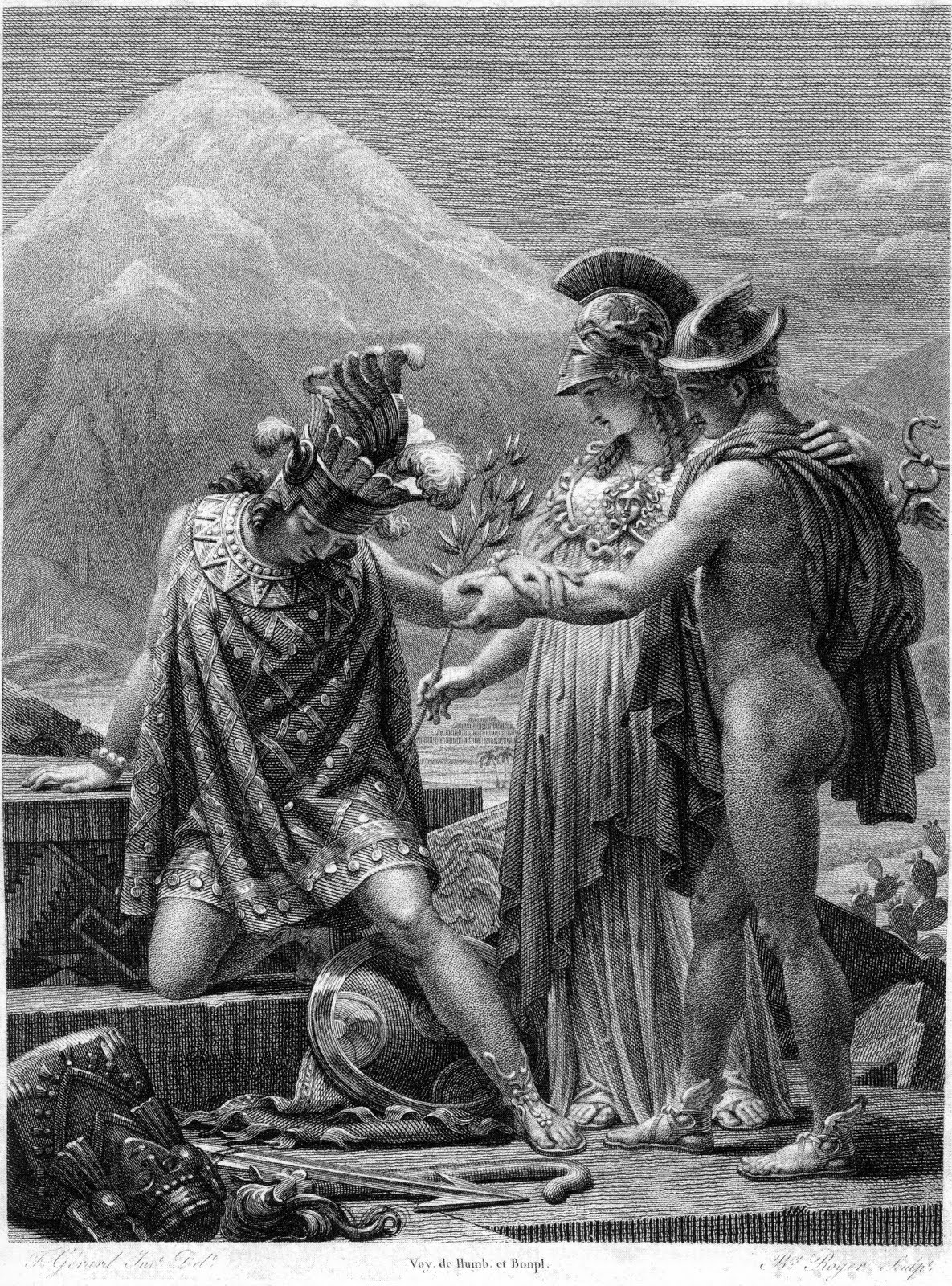
talkpoliticsThis image from the ealy nineteenth century shows two Greek deities rendering assistance to a Native American. The image has some magical content in the sense that includes occult symbols. The Greek deities could be considered to be occult symbols because they are not mentioned anywhere in Judeo-Christian sacred texts. Fundamentalist Christians may even regard them as profane idols.
Neither Athena nor Hermes exist as physical entities, but they have a profound effect on the minds of the superstitious. The messenger of the Greek pantheon is depicted as naked. This alone can stir up a variety of emotional reactions. A dogmatic Franciscan may hasten to wrap the poor boy in his cloak. A typical San Franciscan may think the guy had just come from the Folsom Street Fair. A latent homosexual Texan may see him as a Son of Satan as he ogles the plump derriere.
Anyone who knows a little bit about Masonic initiations will recognize a revival ritual. The Native is being brought back from the domain of the dead. He is given new life like the Lazarus of the Jesus legend. When the self-hating Texan finds out about this secret significance, he will excrete another piece of building material as he realizes the implication of a Greek idol doing something that only Jesus is allowed to do. The Julius worshiper will also drop a prismatic rock as he fears the revival of human sacrifice.
This image brought back memories from a telecommunications project I worked on a number of years ago. As we were testing the equipment, we used a test script that included the name of the ancient icon. A competing organization deliberately corrupted our signal by replacing the name of the character with the name of a viral infection. It was a single phoneme corruption, but the corrupting algorithm actually replaced the entire word. We were able to detect the corruption by breaking the word into syllables. The competing product became part of our test framework for fault injection.
The image appeared in Humboldt's Atlas published at the time of the second revolutionary war with Britain. It has some interesting political implications as it shows European interest in Native American independence. What does this image bring to mind for you? Can you identify any of the other occult symbols in the image and share their meaning with the rest of us?
Neither Athena nor Hermes exist as physical entities, but they have a profound effect on the minds of the superstitious. The messenger of the Greek pantheon is depicted as naked. This alone can stir up a variety of emotional reactions. A dogmatic Franciscan may hasten to wrap the poor boy in his cloak. A typical San Franciscan may think the guy had just come from the Folsom Street Fair. A latent homosexual Texan may see him as a Son of Satan as he ogles the plump derriere.
Anyone who knows a little bit about Masonic initiations will recognize a revival ritual. The Native is being brought back from the domain of the dead. He is given new life like the Lazarus of the Jesus legend. When the self-hating Texan finds out about this secret significance, he will excrete another piece of building material as he realizes the implication of a Greek idol doing something that only Jesus is allowed to do. The Julius worshiper will also drop a prismatic rock as he fears the revival of human sacrifice.
This image brought back memories from a telecommunications project I worked on a number of years ago. As we were testing the equipment, we used a test script that included the name of the ancient icon. A competing organization deliberately corrupted our signal by replacing the name of the character with the name of a viral infection. It was a single phoneme corruption, but the corrupting algorithm actually replaced the entire word. We were able to detect the corruption by breaking the word into syllables. The competing product became part of our test framework for fault injection.
The image appeared in Humboldt's Atlas published at the time of the second revolutionary war with Britain. It has some interesting political implications as it shows European interest in Native American independence. What does this image bring to mind for you? Can you identify any of the other occult symbols in the image and share their meaning with the rest of us?


(no subject)
Date: 24/6/11 16:31 (UTC)Do you have a source for the print? (I'm not saying that as a sarcastic reference to recent events, I just think you can learn a lot about a picture by the context the author lived in)
Humboldt...
Date: 24/6/11 16:45 (UTC)Re: Humboldt...
Date: 24/6/11 17:08 (UTC)(no subject)
Date: 24/6/11 16:44 (UTC)As an Aztec...
Date: 24/6/11 16:54 (UTC)The word savage has its roots in the Latin word for forest: sylva.
Re: As an Aztec...
Date: 24/6/11 16:58 (UTC)Re: As an Aztec...
Date: 26/6/11 18:45 (UTC)Re: As an Aztec...
From:(no subject)
Date: 24/6/11 16:52 (UTC)Independence? After a sort, I guess, but more likely this is an image of paternalism.
You have forgotten...
Date: 24/6/11 16:58 (UTC)Re: You have forgotten...
Date: 24/6/11 17:19 (UTC)Re: You have forgotten...
From:Re: You have forgotten...
From:Re: You have forgotten...
From:Re: You have forgotten...
From:Re: You have forgotten...
From:Re: You have forgotten...
From:Re: You have forgotten...
From:Re: You have forgotten...
From:Re: You have forgotten...
From:Re: You have forgotten...
From:Re: You have forgotten...
Date: 24/6/11 18:52 (UTC)Re: You have forgotten...
Date: 24/6/11 19:25 (UTC)Re: You have forgotten...
From:Re: You have forgotten...
Date: 26/6/11 18:46 (UTC)(no subject)
Date: 24/6/11 17:00 (UTC)(no subject)
Date: 24/6/11 18:27 (UTC)"Take up the White Man's Burden..."
"Do you like Kipling?"
"I don't know, I've never kippled before."
Long before then...
From:(no subject)
From:Thanks...
From:Re: Thanks...
From:(no subject)
From:Her eyes...
From:That sounds like...
Date: 24/6/11 20:02 (UTC)As I noted above, the Aztecs were not considered to be among the "savages" of America.
Re: That sounds like...
From:(no subject)
Date: 24/6/11 22:26 (UTC)Humboldt thought that he was a deified man. IMO the illustration shows Athena and Hermes receiving Quetzalcoatl, a man, in the land of gods.
(no subject)
Date: 24/6/11 23:15 (UTC)Interesting theory...
Date: 25/6/11 00:21 (UTC)Architectural examples can be found here (http://en.wikipedia.org/wiki/File:Xochicalco_Serpiente_Emplumada_GR.jpg) and here (http://en.wikipedia.org/wiki/File:Teotihuacan_Feathered_Serpent_(Jami_Dwyer).jpg).
Re: Interesting theory...
Date: 25/6/11 00:47 (UTC)Re: Interesting theory...
Date: 25/6/11 02:53 (UTC)Re: Interesting theory...
From:Re: Interesting theory...
From:Re: Interesting theory...
From:Re: Interesting theory...
From:Re: Interesting theory...
From:Re: Interesting theory...
Date: 25/6/11 09:40 (UTC)Re: Interesting theory...
From:Re: Interesting theory...
From:Re: Interesting theory...
From:Re: Interesting theory...
From:Re: Interesting theory...
From:Re: Interesting theory...
From:Re: Interesting theory...
From:(no subject)
Date: 26/6/11 18:43 (UTC)You...
Date: 27/6/11 15:57 (UTC)Update on Humboldt
Date: 28/6/11 00:20 (UTC)In addition to this, his writings are imbued with the spirit of republican and religious reform. My initial suspicions seem to have been vindicated.
BTW, I found one of the components of the image above in an English translation of the Atlas including the pyramid in the background and the statue in the foreground.