![[identity profile]](https://www.dreamwidth.org/img/silk/identity/openid.png) malasadas.livejournal.com posting in
malasadas.livejournal.com posting in ![[community profile]](https://www.dreamwidth.org/img/silk/identity/community.png) talkpolitics
talkpoliticsIt is nearly two weeks since the combined forces of a 9.0 earthquake and following tsunami overwhelmed the safety systems at Japan's Fukushima nuclear power station...the news continues to unfold as workers keep trying to cool both the reactors and storage pools for waste and prevent ever more release of radiation. We won't know for some time yet how successful they will ultimately be, but with people advised to not let babies have tap water in Tokyo it is hard to escape the conclusion that matters could still get a lot worse.
Assuming they paused in horror at the still rising death toll in Japan and in honor of the bravery of the workers at the Fukushima plant, one can understand how advocates for expanded nuclear energy could be shaken by the events of the past two weeks. Nuclear has enjoyed something of a revival in favorability given that it is a proven technology that emits no carbon into the atmosphere. In any long term plan to transition the world's energy economy from burning dead dinosaurs, nuclear is a very probable middle term player. In the United States, it already 20% of the electrical power generation even though no new plants have come on line since the late 80s. That is not capacity that can given up easily.
Images like this, however:

...make powerfully emotional arguments against expansion nuclear's role in our energy portfolio...but should they?
The Fukushima crisis is far from resolved, but one rarely heard observation is the fact of what extraordinary circumstances that put the plant in danger of full meltdown in its reactors and storage ponds. A 9.0 earthquake is no ordinary disaster, and the plant would be an object lesson in nuclear safety if the tsunami had not swamped the on site generators for the cooling systems.
I am not remotely an expert, but my layperson's understanding is that nuclear has two significant drawbacks: 1) the generation of waste materials that nobody wants stored or trasnported near them, resulting in many plants being waste disposal as well as power generating facilities and 2) when something goes wrong, the potential for catastrophic consequences is exceptional.
The sheer specter of wide spread radioactive contamination from an accident is not something to be scoffed at. Apart from the risk of accute radiation sickness, the long term health effects of radioactive contamination include putting land out of productive use for years and hugely elevated cancer risks. The problem is that other forms of power production that would replace nuclear are not precisely free of environmental consequences. Coal mining in the U.S. involves mountaintop removal:

And coal ash storage? It has recently shown its own risks:
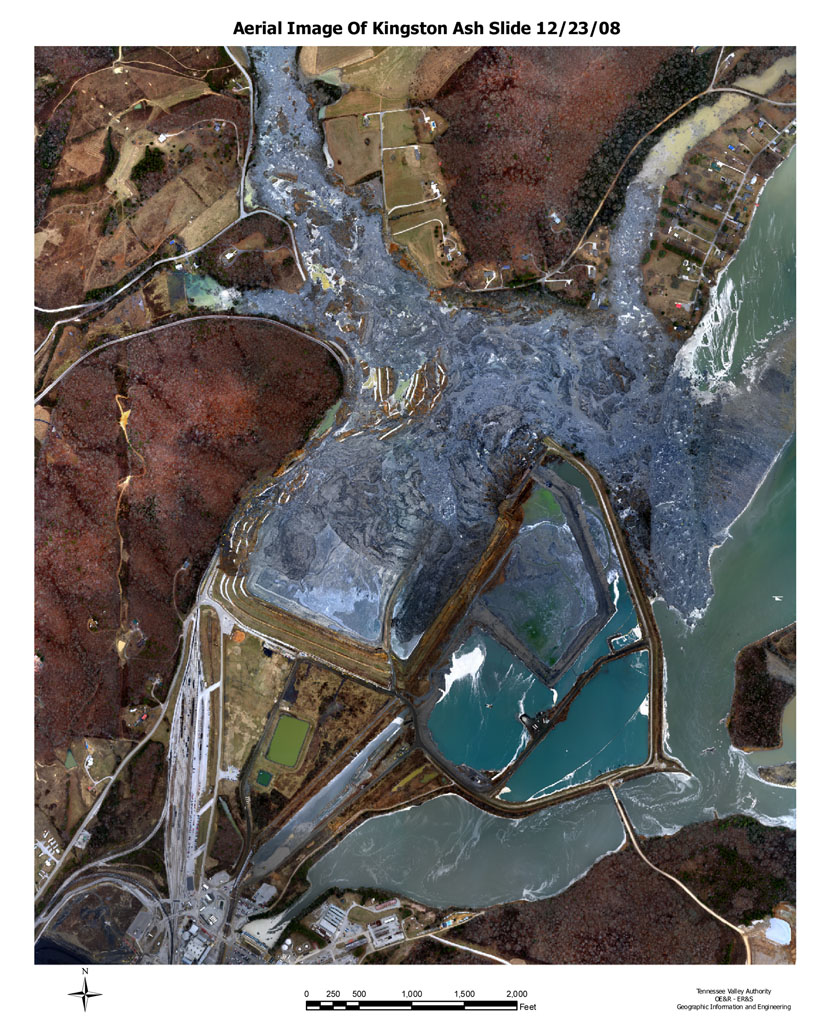
The truth is that civilization is messy -- it takes energy and the industry that supports it is still one that extracts, processes and produces hazardous waste materials. Imagine the world without aluminum. The usefulness of the material was probably small comfort the Hungarian villages inundated last Fall by a river of red sludge byproducts from alumina processing:

The basic question, and one I honestly have no real answer for, is what IS the break point? At what point does any energy source become too costly for human and environmetnal health not because of what it routinely creates, but because the outlier possible consequences are too high to ever allow to happen?
Assuming they paused in horror at the still rising death toll in Japan and in honor of the bravery of the workers at the Fukushima plant, one can understand how advocates for expanded nuclear energy could be shaken by the events of the past two weeks. Nuclear has enjoyed something of a revival in favorability given that it is a proven technology that emits no carbon into the atmosphere. In any long term plan to transition the world's energy economy from burning dead dinosaurs, nuclear is a very probable middle term player. In the United States, it already 20% of the electrical power generation even though no new plants have come on line since the late 80s. That is not capacity that can given up easily.
Images like this, however:
...make powerfully emotional arguments against expansion nuclear's role in our energy portfolio...but should they?
The Fukushima crisis is far from resolved, but one rarely heard observation is the fact of what extraordinary circumstances that put the plant in danger of full meltdown in its reactors and storage ponds. A 9.0 earthquake is no ordinary disaster, and the plant would be an object lesson in nuclear safety if the tsunami had not swamped the on site generators for the cooling systems.
I am not remotely an expert, but my layperson's understanding is that nuclear has two significant drawbacks: 1) the generation of waste materials that nobody wants stored or trasnported near them, resulting in many plants being waste disposal as well as power generating facilities and 2) when something goes wrong, the potential for catastrophic consequences is exceptional.
The sheer specter of wide spread radioactive contamination from an accident is not something to be scoffed at. Apart from the risk of accute radiation sickness, the long term health effects of radioactive contamination include putting land out of productive use for years and hugely elevated cancer risks. The problem is that other forms of power production that would replace nuclear are not precisely free of environmental consequences. Coal mining in the U.S. involves mountaintop removal:
And coal ash storage? It has recently shown its own risks:
The truth is that civilization is messy -- it takes energy and the industry that supports it is still one that extracts, processes and produces hazardous waste materials. Imagine the world without aluminum. The usefulness of the material was probably small comfort the Hungarian villages inundated last Fall by a river of red sludge byproducts from alumina processing:
The basic question, and one I honestly have no real answer for, is what IS the break point? At what point does any energy source become too costly for human and environmetnal health not because of what it routinely creates, but because the outlier possible consequences are too high to ever allow to happen?


(no subject)
Date: 25/3/11 02:44 (UTC)But seriously, a major problem with having an intelligent public debate about this kind of thing is that most people's thoughts on such issues are of the order of the mental equivalent to a internet macro complete with scary picture and sarcastic blurb.
So I guess an argument composed entirely of macros with scary pictures and sarcastic blurbs suggesting that nuclear power is or isn't worse than other options is an apropos response.
(no subject)
Date: 25/3/11 03:25 (UTC)Just a word to those interpreting - there's nothing in the numbers that this is based on about quality of life, environmental damage, or the like. Just deaths directly attributable to the power generation.
(no subject)
Date: 25/3/11 03:29 (UTC)(no subject)
Date: 25/3/11 03:28 (UTC)If this be it the case, then may I suggest someone concoct a micro briefing in layman's terms. Care to volunteer? Me? No, as I am one of those who believes there to be an environmental cost to every harnessed by man.
(no subject)
Date: 25/3/11 03:53 (UTC)I mean, I genuinely think that provided they communicate the real facts, that people tend to be far easier to educate with macros than with any number of pages of data. The "real facts" part inevitably being the pitfall.
(no subject)
Date: 25/3/11 04:11 (UTC)besides, the real facts if fully understood would only leave the general public (i to am included) with the outlook of "we're doomed if we do & we're doomed if we don't." i do however see much need to further develop alternative biofuels, solar, hydro, and wind energy harnessing. that 20% previously mentioned could easily be replaced by other methods in my opinion.
(no subject)
Date: 25/3/11 10:22 (UTC)You're welcome (http://wigflip.com/roflbot/).
(no subject)
Date: 25/3/11 03:37 (UTC)(no subject)
Date: 25/3/11 03:48 (UTC)So I think that would mean each .1 on the Richter scale is about 26% more powerful than the one before.
Factor - Relative Strength
1.0 1
1.1 1.26
1.2 1.5876
1.3 2.000376
1.4 2.52047376
1.5 3.175796938
1.6 4.001504141
1.7 5.041895218
1.8 6.352787975
1.9 8.004512848
2.0 10.08568619
(no subject)
Date: 25/3/11 04:10 (UTC)At least that is my understanding of the difference between the 2 numbers reported.
(no subject)
Date: 25/3/11 06:23 (UTC)Google "Richter Scale" and look at a couple of the first links (I didn't look at the wikipedia one myself) and you should get a good quick explanation of it.
(no subject)
Date: 25/3/11 04:22 (UTC)Earthquakes strengths have to be calculated from a number of variable and often uncertain factors, e.g. epicentre location, type of materials the shockwaves are being transmitted through etc.
(no subject)
Date: 25/3/11 04:29 (UTC)(no subject)
Date: 25/3/11 04:27 (UTC)(no subject)
Date: 25/3/11 03:29 (UTC)(no subject)
Date: 25/3/11 03:45 (UTC)imo, that is not normally for the engineers to decided & it is unfortunately so. it seems, that business & politics seems to somehow quite the engineer time and time again.
Safety is a low priority...
Date: 25/3/11 04:18 (UTC)Then politicians say "Oh, but that technology while safer, may make it possible for people we don't like to have nuclear weapons, so you have to use this less safe technology."
Then weasels say "You can't build that processing plant next to the reactor, it has to be built 500 miles away to give contracts to my friends and promise jobs to people who vote for me.
Re: Safety is a low priority...
Date: 25/3/11 04:24 (UTC)Re: Safety is a low priority...
Date: 25/3/11 04:36 (UTC)Given time he also tries to outwit idiots, and tries to prevent such clever tricks as avoiding the safety interlock by wedging a phone book in the door or cutting the wires to the warning klaxon. It is something of a loosing battle, the universe is effectively an infinite idiot factory.
Re: Safety is a low priority...
Date: 25/3/11 05:04 (UTC)And I believe the Engineering operating Principle is: "Yes, yes it will. All the time."
Re: Safety is a low priority...
Date: 25/3/11 05:13 (UTC)you took that verbatim from someone didn't you?! HILARIOUS!
Re: Safety is a low priority...
Date: 25/3/11 05:15 (UTC)Re: Safety is a low priority...
Date: 25/3/11 05:18 (UTC)Re: Safety is a low priority...
Date: 25/3/11 21:40 (UTC)But even the most wary engineers make critical errors. The difference is that they tend to admit and accept responsibility for those errors. Nothing promotes a sense of caution like knowing its your ass on the line, ie: taking responsibility. And even so, we still error.
I have this problem myself, and I believe in code reviews and yet I still allow myself to be bitten in the ass for my ego or my pride or some other dumb shit. This is after 20 years in the industry, I should know better but still fail.
Odd.
Re: Safety is a low priority...
Date: 25/3/11 05:14 (UTC)Re: Safety is a low priority...
Date: 25/3/11 17:43 (UTC)(no subject)
Date: 25/3/11 17:42 (UTC)The plant itself was fine. The plants NEAR THE EPICENTER of the quake were fine. It was the off-site diesel generators that got messed up by the tsunami. They were built above sea water, meant to withstand a tsunami, but not a 46-foot one.
The lesson here is that despite everything that's happened to these plants, they have fared a lot better than everyone expected and that's considering they're really old models with outdated technologies. Newer technologies use gravity for water cooling so knocking out the power wouldn't stop the cooling.
Also I'm glad you mentioned the 20% power statistic. I mentioned this several times in previous posts in case people thought we weren't already using old-ass reactors to generate a significant portion of our power.
As for the precautions they are taking in light of heightened radiation readings- they're being very careful. These limits and warnings are extremely over-conservative, like 25 times EPA standards. I don't mind that they are doing it this way, I mean you can never be too safe, but that it's some indication of some huge nuclear fallout is a fallacy.
(no subject)
Date: 25/3/11 18:39 (UTC)Two workers were hospitalized from radiation when they stepped in water with 10,000 times acceptable values in the control room.
(no subject)
Date: 25/3/11 19:06 (UTC)But as you and I discussed in the other thread, those safety standards are extreamly conservative (by design), and that on a "danger per mega-watt" scale Nuclear power still comes out looking pretty good in comparison to other power generation methods .
(no subject)
Date: 25/3/11 21:36 (UTC)10 years?
30 years?
100 years?
1000 years?
Short term thinking is skewing this measurement. Also sheer ignorance.
How do we account for the epidemic of cancer in America?
We know that background radiation is the cause for a certain amount of cancers before the industrial age, but what of the recent increases?
I'm say we're pretty blind.
There is a perfectly good nuclear reactor in the sky we should learn to use.
(no subject)
Date: 26/3/11 00:05 (UTC)(no subject)
Date: 26/3/11 02:06 (UTC)(no subject)
Date: 26/3/11 02:23 (UTC)(no subject)
Date: 26/3/11 05:25 (UTC)To compare this to 3 mile Island is to minimize the situation - during the situation.
(no subject)
Date: 27/3/11 00:03 (UTC)If you really cared about your kids, you would try to make sure their futures aren't dominated by oil-rich foreign entities. You would replace the OLD REACTORS THAT ARE GIVING THEM POWER RIGHT NOW with newer reactors that are more efficient and safer.
(no subject)
Date: 27/3/11 18:28 (UTC)For visiting Fukushima, per the thread.
Nothing happened to the core
I don't see how anyone can assert that as fact, considering the Japanese engineers do not have that information. Last I heard they suspected a leak in 3 since they have higher level a radiation that they can otherwise explain.
If you really cared about your kids,
:-) You have a nice weekend.
(no subject)
Date: 27/3/11 21:05 (UTC)You have no reply to the fact that your computer is being powered by old nuclear reactors right now, and your attitude has prevented us from building newer, more efficient, safer plants to replace our old ones.
(no subject)
From:(no subject)
Date: 26/3/11 21:18 (UTC)Otherwise, from an engineering standpoint solar power introduces almost as many problems as it solves. Most specifically the requirement for large amounts of Rare-earth minerals in thier construction and the need for high-capacity storage banks. (for when the Sun's down or if it's cloudy) In short, until someone invents a room-temprature super-conductor, large scale solar-power is going to involve more toxic chemicals than a Nuke or Coal plant of similar capacity.
Over the timeline for which we have data for, specifically the last 50 years or so nukes have come out ahead in pretty much every catagory. So here is a question, what do you consider the worst case scenario? and how does it compare to the alternatives?
(no subject)
Date: 27/3/11 18:30 (UTC)Yeah, this is being worked on and sand is way more abundant and accessible than uranium. (Nuclear also has the same issue.)
large scale solar-power is going to involve more toxic chemicals than a Nuke or Coal plant of similar capacity.
*citiation needed.
It's an Engineering problem...
Date: 27/3/11 20:40 (UTC)For the most part all three require the processing of minerals that are either rare (http://en.wikipedia.org/wiki/Cadmium_telluride#Toxicity) or toxic (http://en.wikipedia.org/wiki/Gallium_arsenide), and this is simply in the manufacture of the cells themselves.
Because the sun is not up 24 hours a day, large scale reliance on solar power would also mean an increased reliance on power storage(batteries) and transmission (wires).
This introduces it's own set of obsticals.
As it stands, transmission loss (http://www.microwaves101.com/encyclopedia/transmission_loss.cfm) need to be factored into the projected output of any energy source. Increasing the amount of tranmission will proprtionally increase the amount of loss. Large scale super-conductors still belong to the realm Science Fiction so barring a MAJOR scientific breakthrough this problem is not going away.
The other issue is batteries. Rechargable batteries have a limited life-span. This means (Once again, barring a major scientific advance) that every few years large amounts of lithium, mercury, and cadmium and lead will need to be processed and/or disposed of.
Just run a search for electronic/battery waste and multiply the current enviromental effects by "x" where "x" is the number of batteries required to store the amount of electricity generally used by a developed nation.
In my experiance, the majority of advocates for solar power fail to consider these issues. Now this is not to say that solar power shouldn't play a part in reducing local demand but barring the afore-mentioned scientific breakthroughs solar power on a large scale will remain impractical when compared to other alternatives.
(no subject)
Date: 27/3/11 18:32 (UTC)Making swaths of habitat uninhabitable for years. Increasing cancer rates, mostly in children. Someone takes the waste and makes a clean or dirty bomb.
That sort of thing.
(no subject)
Date: 27/3/11 20:53 (UTC)If result of the Soviets hadn't been using graphite (which is flammable) as a control-substance Chernobyl would never have been famous.
So the question remains, do you honestly believe that the spector of what may happen is worse than the things that already have? (please re-read the OP and comments before responding)
I say "no, it is not".
(no subject)
Date: 27/3/11 21:07 (UTC)(no subject)
Date: 27/3/11 21:13 (UTC)Extremely unlikely. It is impossible to produce another Chernobyl-era disaster with any current plant.
Increasing cancer rates, mostly in children.
You keep touting this opinion as fact. Either source it to a scientific study, or drop it. And don't link to something in Chernobyl, you started with saying that current plants are causing this.
Someone takes the waste and makes a clean or dirty bomb.
Impossible. You have no idea what the waste is and what goes into a nuclear explosive. If you think someone is going to casually walk into a nuclear facility and walk out with a 10-ton container like Superman then I don't know what to tell you. Even then it's not the right kind of material for a bomb.
You need to wake up. Your fear-mongering nonsense is not needed in the 21st century.
(no subject)
Date: 27/3/11 21:38 (UTC)(no subject)
Date: 27/3/11 23:33 (UTC)There is no such thing as progress if EVERY CASE is THE WORST CASE SCENARIO.
(no subject)
Date: 28/3/11 20:54 (UTC)