![[personal profile]](https://www.dreamwidth.org/img/silk/identity/user.png) fridi posting in
fridi posting in ![[community profile]](https://www.dreamwidth.org/img/silk/identity/community.png) talkpolitics
talkpoliticsWhile most media in the Land of the Free were mostly occupied with the umpteenth Tweet-storm between the Douche-in-Chief and the father of the basketball player who had been released from Chinese jail after a request from the former (which he now says he regretted), Putin sat in his villa in Sochi with some high dignitaries, and he was busy revising the geopolitical fate of the Middle East. Savor the discrepancy of scale.
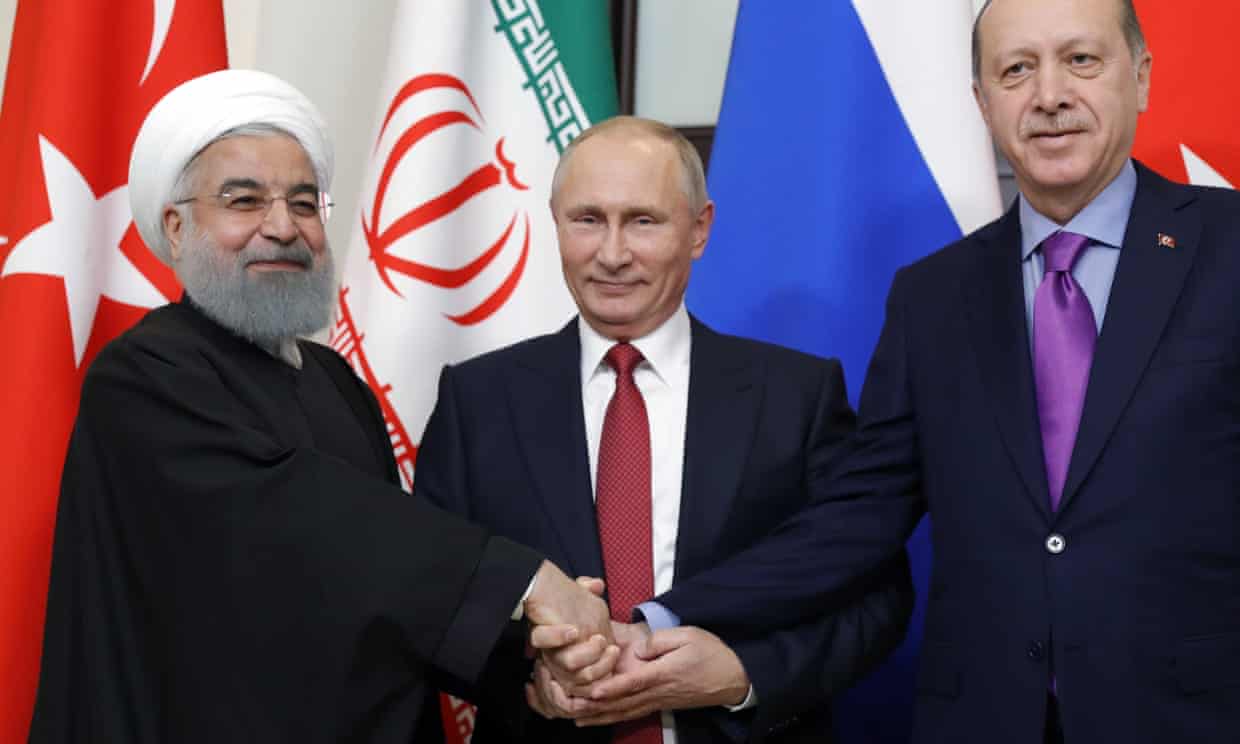
First, Bashar Assad surprisingly showed up to personally thank Putin for Russia's immense help in keeping his head on his shoulders, and to promise he'd cooperate with Russia's effort to solve the Syrian issue - knowing that his removal from power was no longer among the key conditions for the furthering of that process. Then Putin called Saudi king Salman to inform him of the negotiations and get assurances from him that the Saudis would allow some staff changes in the Syrian opposition, aiming to remove the most vocal opponents to a potential truce with Assad. Finally, the presidents of Iran and Turkey also arrived for the trilateral talks with their Russian host, and they discussed the transition period in Syria. Later, Putin called Trump to inform him of all the proceedings, but his tone left no ambiguity about the fact that Russia was informing the US out of mere courtesy, not seeking any advice, feedback, or least of all, a green light for their actions. And definitely no US involvement in the talks about Syria's future.
Trump wanted America for Americans, and he got it. America is left on its own, and out of important geopolitical processes. It's but a mere spectator now. That's where self-isolationism gets you.
All in all, the US reaction fits three predictable chiches. First: the "leave them all deal with the problem if they so much insist" approach, which naturally emerges from the "America first" attitude. Second: the one based on the assumption that "Russia is doomed to failure", and the assumption that the US has nothing to worry about, since Russia is hapless anyway. And third: the one related to the moralist posturing and America's reluctance to engage in any initiatives where the "butcher of Damascus" is participating. What these three approaches have in common is the admission that the US doesn't want to get seriously involved in the Syrian gambit, settling for a bystander's position. But what's much more important is that the players on whom the US policy in the region used to lean upon, are now changing approach - and reviewing their loyalties.
See, the main feature of US interventions overseas for the last couple of decades is that America has used its vast technological, financial and military (mostly air-force, because that's safer and more convenient) capabilities to support various local proxies and puppets around the world. In Syria, the US relied on two main allies, Turkey and Saudi Arabia, to support and help the anti-government opposition. They relied on the Kurdish population to form the core of the anti-ISIS forces. All three local players, however, no longer trust the US assurances (because the US has demonstrated time and time again that they don't shy away from stabbing their partners in the back as long as it suits their interests), so they're now turning to Russia, hoping it'd provide an alternative (and some assistance with bagging a few nice trade deals in the region).
Could Russia be over-reaching? Sure. Might they ultimately fail? No doubt it's possible. The skeptics may not be so wrong to point at a number of problems that Putin is facing. But the truth is, Russia wins in all cases, even in the worst-case scenario - because they're the active side here, they're dictating the dynamics. What's more important, that meeting in Sochi is yet another confirmation that a new configuration of powers is forming in the Middle East.
In recent times, Erdogan has been meeting with Putin more frequently than he's dealing with his nominal allies in Europe and America. He has radically changed position, and now he no longer believes it's in Turkey's interest to block the expansion of the Russian interests in the Eastern Mediterranean on behalf of his Western partners. He now believes they don't really care about Turkey's interests. So why not strike a mutually beneficial deal with Russia instead? Simply relying on the historic animosity between Russia and Turkey to see Putin's ambitions halted, means to ignore the periods where the two powers have successfully cooperated for the sake of furthering their shared interests.
Actually, why should Turkey be bearing the bulk of the burden about isolating Iran? Why should Turkey be confrontational to Iran, really? Why not sit at the table with the Iranians and reach an agreement that would suit both Turkish and Iranian interest? Why waste resources and efforts for a needless confrontation? For Rouhani, the trilateral axis with Turkey and Russia, along with the North-South transport corridor guarantees an ending of Iran's political and economic isolation. The US sanctions would be rendered meaningless in these circumstances.
As for Putin, this new arrangement with the two biggest regional powers (and Russia's former geopolitical foes) is an important move (and a possible justification) for his own approach to international politics. The one no longer based on the utopian "global" 21st century. The one that reverts to more traditional 19th century politics of spheres of influence. In Syria, he's already achieved some success on reaching a truce and establishing certain de-escalation zones. So, once some success has been made on the Syrian crisis (without US participation), why not further use this trilateral format to try address other issues, from the Kurdish question to the frozen conflict in Nagorny-Karabakh (between Armenia and Azerbaijan)? What Putin must have convinced Putin about (as far as Iran is concerned, they're already convinced) is that all regional problems could be tackled without America's involvement. And the three must be liking the idea.
What's Russia hoping to achieve with all that, you may ask. We're not just talking of diplomatic prestige. Putin's main argument is that the region of the Black Sea and Caspian Sea doesn't need US presence and involvement. The radical chance in Turkey's position (a staunch Western ally, and biggest hurdle to Russian expansion), now effectively turned into a neutral regional player, is Putin's biggest geopolitical success. Still, if they're to play their cards right, the Russians would need to neutralize the US efforts to isolate them, and this includes the sanctions. Putin doesn't just want to get international recognition for his diplomacy - he wants to form a wider circle of supporters who are interested in actively supporting Russia, thus legitimizing it as one of the world's great powers again.
If Russia manages to show the rest of the world that its preferred model of transactional agreements is working fine, we should expect Putin to try to reproduce it in East Asia next.
First, Bashar Assad surprisingly showed up to personally thank Putin for Russia's immense help in keeping his head on his shoulders, and to promise he'd cooperate with Russia's effort to solve the Syrian issue - knowing that his removal from power was no longer among the key conditions for the furthering of that process. Then Putin called Saudi king Salman to inform him of the negotiations and get assurances from him that the Saudis would allow some staff changes in the Syrian opposition, aiming to remove the most vocal opponents to a potential truce with Assad. Finally, the presidents of Iran and Turkey also arrived for the trilateral talks with their Russian host, and they discussed the transition period in Syria. Later, Putin called Trump to inform him of all the proceedings, but his tone left no ambiguity about the fact that Russia was informing the US out of mere courtesy, not seeking any advice, feedback, or least of all, a green light for their actions. And definitely no US involvement in the talks about Syria's future.
Trump wanted America for Americans, and he got it. America is left on its own, and out of important geopolitical processes. It's but a mere spectator now. That's where self-isolationism gets you.
All in all, the US reaction fits three predictable chiches. First: the "leave them all deal with the problem if they so much insist" approach, which naturally emerges from the "America first" attitude. Second: the one based on the assumption that "Russia is doomed to failure", and the assumption that the US has nothing to worry about, since Russia is hapless anyway. And third: the one related to the moralist posturing and America's reluctance to engage in any initiatives where the "butcher of Damascus" is participating. What these three approaches have in common is the admission that the US doesn't want to get seriously involved in the Syrian gambit, settling for a bystander's position. But what's much more important is that the players on whom the US policy in the region used to lean upon, are now changing approach - and reviewing their loyalties.
See, the main feature of US interventions overseas for the last couple of decades is that America has used its vast technological, financial and military (mostly air-force, because that's safer and more convenient) capabilities to support various local proxies and puppets around the world. In Syria, the US relied on two main allies, Turkey and Saudi Arabia, to support and help the anti-government opposition. They relied on the Kurdish population to form the core of the anti-ISIS forces. All three local players, however, no longer trust the US assurances (because the US has demonstrated time and time again that they don't shy away from stabbing their partners in the back as long as it suits their interests), so they're now turning to Russia, hoping it'd provide an alternative (and some assistance with bagging a few nice trade deals in the region).
Could Russia be over-reaching? Sure. Might they ultimately fail? No doubt it's possible. The skeptics may not be so wrong to point at a number of problems that Putin is facing. But the truth is, Russia wins in all cases, even in the worst-case scenario - because they're the active side here, they're dictating the dynamics. What's more important, that meeting in Sochi is yet another confirmation that a new configuration of powers is forming in the Middle East.
In recent times, Erdogan has been meeting with Putin more frequently than he's dealing with his nominal allies in Europe and America. He has radically changed position, and now he no longer believes it's in Turkey's interest to block the expansion of the Russian interests in the Eastern Mediterranean on behalf of his Western partners. He now believes they don't really care about Turkey's interests. So why not strike a mutually beneficial deal with Russia instead? Simply relying on the historic animosity between Russia and Turkey to see Putin's ambitions halted, means to ignore the periods where the two powers have successfully cooperated for the sake of furthering their shared interests.
Actually, why should Turkey be bearing the bulk of the burden about isolating Iran? Why should Turkey be confrontational to Iran, really? Why not sit at the table with the Iranians and reach an agreement that would suit both Turkish and Iranian interest? Why waste resources and efforts for a needless confrontation? For Rouhani, the trilateral axis with Turkey and Russia, along with the North-South transport corridor guarantees an ending of Iran's political and economic isolation. The US sanctions would be rendered meaningless in these circumstances.
As for Putin, this new arrangement with the two biggest regional powers (and Russia's former geopolitical foes) is an important move (and a possible justification) for his own approach to international politics. The one no longer based on the utopian "global" 21st century. The one that reverts to more traditional 19th century politics of spheres of influence. In Syria, he's already achieved some success on reaching a truce and establishing certain de-escalation zones. So, once some success has been made on the Syrian crisis (without US participation), why not further use this trilateral format to try address other issues, from the Kurdish question to the frozen conflict in Nagorny-Karabakh (between Armenia and Azerbaijan)? What Putin must have convinced Putin about (as far as Iran is concerned, they're already convinced) is that all regional problems could be tackled without America's involvement. And the three must be liking the idea.
What's Russia hoping to achieve with all that, you may ask. We're not just talking of diplomatic prestige. Putin's main argument is that the region of the Black Sea and Caspian Sea doesn't need US presence and involvement. The radical chance in Turkey's position (a staunch Western ally, and biggest hurdle to Russian expansion), now effectively turned into a neutral regional player, is Putin's biggest geopolitical success. Still, if they're to play their cards right, the Russians would need to neutralize the US efforts to isolate them, and this includes the sanctions. Putin doesn't just want to get international recognition for his diplomacy - he wants to form a wider circle of supporters who are interested in actively supporting Russia, thus legitimizing it as one of the world's great powers again.
If Russia manages to show the rest of the world that its preferred model of transactional agreements is working fine, we should expect Putin to try to reproduce it in East Asia next.


