Not so funny any more?
30/5/16 14:59![[identity profile]](https://www.dreamwidth.org/img/silk/identity/openid.png) luvdovz.livejournal.com posting in
luvdovz.livejournal.com posting in ![[community profile]](https://www.dreamwidth.org/img/silk/identity/community.png) talkpolitics
talkpolitics
There was a time when it used to be funny. At first, Trump's ascent mostly caused smirks with his bombastic, absurd utterances. But things have changed. The delegate count showed last Thursday that Trump had reached the coveted number, 1238. Cruz is out, Kasich is out, Rubio is out (poor tool). Now the July convention will formalize Trump's nomination. And it was supposed to be a contested convention. But now Trump's path to the general election is cleared. Only a miracle could torpedo him, and the risk is of a huge backlash in such a case. So now he'll face Hillary most likely, although both are suffering record disapproval ratings. A contest among two evils, where voters will have to choose the lesser of them. Doesn't sound very inspiring, eh? Hope & Change, that's all gone. Now it's Choose The Less Bad. Duh.
Tons of ink have been spilled over this in recent months. All sorts of predictions are being made as to the domestic and international effects of a possible Trump presidency, or even a Trump nomination. His very presence at the scene has already brought the debate way backwards and downwards. Statements that used to be considered unacceptable for years have come back to the surface, and strayed the discourse off any norm imaginable. And, while the domestic damage from a Trump presidency might be mitigated by the checks and balances of Congress and the other institutions, in foreign policy the effects could be truly catastrophic. It could send a shockwave through most of the world, with dire consequences. Now, I'm the last person you'd see jumping on the alarmist bandwagon, but this one time things are starting to look rather serious.

Make America Great Again!, Trump likes yelling at the jubilant audience. And he has every reason to be so triumphant. He has gone a long way, which is remarkable for someone whom no one used to take seriously. And now he's the nominee. And only a miracle (or himself pulling off the biggest troll stunt in history and gleefully quitting at the last minute) could change this.
It's been morbidly fascinating to observe the internal civil war within the GOP that Trump has caused. Top party elders have vowed to refrain from endorsing him, others have gone even further and said they'd rather vote for Hillary. It's not just his obscene comments, his disparaging of women, immigrants, Muslims, or just about anyone he could think of. It's the strain of ideological impurity that he has infused like a poison into the party's bloodstream. And they've brought this upon themselves. Lindsay Graham said the GOP would be destroyed if they nominate Trump, "and we'll deserve it". Cruz has called him a pathological liar. Now the question is, would the Republicans hold their nose and shove the billionaire down their own throats no matter what, or the party would split up eventually. Those who don't want to support Trump have three options: abstain, vote Clinton, or hope for a third candidate (here's the chance of the otherwise obscure Libertarian Party, the eternal third horse in a two-horse race). But either of these options would mean at least another 4 years of exile from the White House.
Still, Trump, being the increasingly skilled player that he is, has done some steps to tone it all down. He has met with Paul Ryan, who had vowed not to support him. Now they're both parroting the slogan that they're committed to the party's unity. Although Ryan was a bit cautious in his wording, using phrases like "it's the beginning of a process", and "casting the seeds". The question remains, though, if the party elite would accept the emergence of a new pro-Trump wing within the GOP.

So how about looking at the party base for answers. For instance, recent polls suggest that 2/3 of the Republican supporters favor Trump's Muslim-banning idea. Another poll showed that Trump has not only closed the gap behind Hillary, he may've started beating her, albeit by a tiny bit. RealClearPolitics calculates a 43.4 vs 43.2 score in Trump's favor. But even if that's not so, Clinton's two-digit lead seems to be gone. It'll be pretty damn close. Some polls suggest that Sanders could've had even better chances of beating Trump than Hillary now has. Which should be a cause for concern - and not just for Democrats, but for Republicans as well, as a potential Trump presidency would likely transform their party irreparably - and in ways that few of them might like.
Hillary's woes don't end with Bernie's reluctance to call it quits, despite his narrowing path to nomination. That email scandal keeps biting her on the ass no matter what she does. And if the FBI investigation concludes that she did a crime in the way she handled that classified information, that could mean an abrupt end to her White House hopes.
So what went wrong here? Trump has humiliated those who used to believe the GOP establishment could easily contain him, and may've proven that the party is full of Homer Simpson type of losers. He also showed that the white (predominantly male) middle-class segment may still be the key to the GOP nomination, but young urban Republicans also tend to gravitate towards the billionaire's populist message. Trump has exploited a promise that many have failed to deliver upon, regarding the workers class, which has been affected by unemployment and stagnant wages for years. They've witnessed the spread of globalization, migration and free trade, and they're feeling increasingly marginalized. The US economy might seem to be growing, but that certainly hasn't translated into increased prosperity for those segments. Paradoxically, Trump has somehow managed to send the message that even from his luxurious glass tower, he's able to see those troubles and understand the pain of the "poorly educated" that he "loves" so much. At times of economic strife (or stagnation), populist messages always tend to win big. Just say the establishment doesn't care about the real folks, and that you're anti-establishment - and you've already got a huge support behind you among the "real folks". A surprisingly sizable and influential base, as it turns out.

Trump has ruffled quite a few feathers. Obama himself ventured into those deep waters, saying the world's leaders have a good reason to be "rattled" by the billionaire's statements, which were so full of ignorance about the world's affairs. He said Trump only cares about what's in the headlines instead of what's necessary for keeping the country safe and prosperous. He probably meant Trump's controversial comments about the US relations with Russia and China, which he hinted should be modified through the position of power. He hinted support for torture of terror suspects. He hinted about NATO skepticism ("NATO is unfair to us"), accusing the major US allies of not contributing a fair share for defense and taking advantage of the US military might (good point). He has hinted he's open to a new type of organization based in Europe that would focus on fighting the paramilitary hybrid type of foes. But that stance of his is in direct conflict with various top factors in both Europe and the US, who consider NATO a "fundamental alliance". On top of that, at a time when the world is talking of cutting nuclear arsenals, Trump is proposing Japan and South Korea to develop their own, "to defend themselves from their enemies". Not very consistent with the otherwise hands-off aura that he has tried to build around himself.
Trump's "America First" speech from last month has also caused concern. Some have started questioning if he has a touch with reality at all. The thing is, the architecture of global security has changed to the point where it mostly rests upon two pillars. It can no longer be run unilaterally. No US president could bypass these new realities. And America First was definitely not an adequate response to this reality. It was a fantasy. And a dangerous one. The trouble is that in his attempt to look fairer to America itself, Trump would ultimately make America's allies less safe, and hance, America, too. He's saying the US allies should rest assured of America's support, but in fact his entire rhetoric suggests that the US would become more volatile, more whimsical, less predictable, less reliable, and at the end of the day, her allies would have to fend for themselves. And this promises a lot of instability. One that would ultimately backfire on America.
Trump's utterances have forced a number of European officials to be more cautious about their public comments about him. Still, the German vice-chancellor has called Trump (along with the leaders of the European right-wing parties) "a threat not just to peace but to economic development". If even a fraction of Trump's election promises become reality, that would mean a huge American withdrawal from world affairs. That would put international relations in jeopardy on many levels, it would undermine a number of bilateral and multilateral defense agreements, it would revise almost all trade agreements from the last few decades, and would hammer other big players like China with heavy protectionist barriers, and force them to retaliate, ultimately disrupting international trade relations for years ahead. If Trump the president looks anything remotely similar to what Trump the candidate describes, the entire global security system would be shaken, and the open global economy would be shut down with a bang. The only consolation here being that presidential candidates tend to speak one thing during campaigns, then swiftly backpedal and get in line, once they've found their ass sitting in the Oval Office, as they quickly realize that the world is actually much more complex than they might've initially thought.
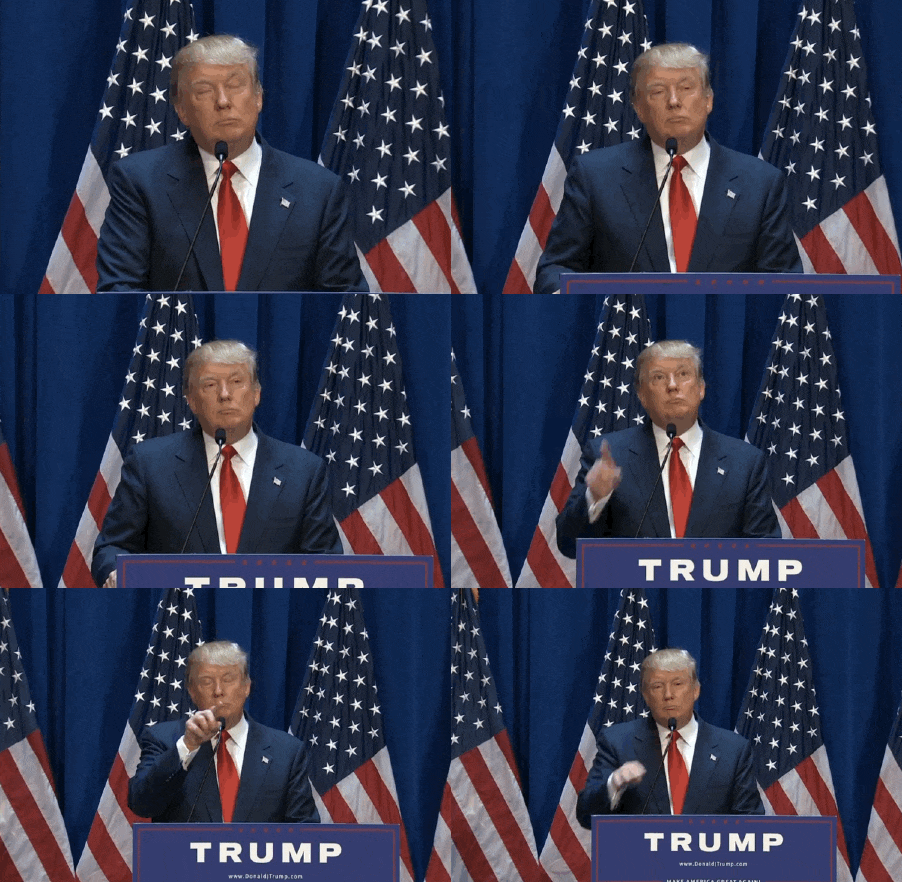
Sure, Trump's big battle is still ahead. If he wants to become president, he'll have to earn the support of segments that he's not doing good among, at all. Some of them he has gone to tremendous lengths to alienate, actually. His options include pandering more to the Latinos (he'd have to forget about the deportation idea, or at least water it down somewhat; and forget about Mexico paying for that Big Beautiful Wall), or more African Americans (tough job there, too - the Clintons have an almost divine status among that segment), or more women (Hillary is strong there; and remember his misogynist credentials), and more blue-collar workers who've consistently voted Democrat (he might have a shot there). Although out of those groups the former two may look like a lost cause, he'll have to work hard to get the latter two on his side. But we've already seen that whoever has underestimated him has paid dearly, so... who knows! The US might end up with a President Trump after all. And it'll all suddenly stop being so funny.


(no subject)
Date: 30/5/16 12:04 (UTC)(no subject)
Date: 30/5/16 12:06 (UTC)(no subject)
Date: 30/5/16 12:14 (UTC)(no subject)
Date: 30/5/16 12:08 (UTC)(no subject)
Date: 31/5/16 00:26 (UTC)(no subject)
Date: 31/5/16 06:57 (UTC)(no subject)
Date: 31/5/16 08:28 (UTC)2) Journalists do not represent people and very often don`t know what people really think. Journalists ask their own friends and relatives: "Would you vote for Trump?" Get negative answers and think that everybody feels the same way. That`s what you get when you ask the majority: you get surprised.
That looks exactly like the First Free And Democratic Parlamentarian Elections in Russia in December, 1993. All TV-chanells were exclusively and radically democratic. Communists were disgraced but feared of (because they were still pretty popular among elder people), Yeltsin`s companions were praised and supported by journalists (including CNN, BBC and other civilised and democratic media). There were also some other very democratic, but different from Yeltsin`s, parties. And there was Zhirinovsky. A nationalist, a wannabe dictator, a demagogue, a clown.
And there was the night of counting the votes... Yeltsin`s party got 64 seats in Duma, Communists - 42, Agrarians - 37, "Yabloko" (very democratic) - 27, and so on; independent got 130.
Zhirinovsky ... 64.
And that was a surprise in live TV show! Neither journalists, nor political analysts could explain how could that happen.
Zhirinovsky is still in Russian Duma.
(no subject)
Date: 31/5/16 08:37 (UTC)There'll always be room for populists - as long as dumbness permeates sufficiently large segments of society.
(no subject)
Date: 31/5/16 08:42 (UTC)(no subject)
Date: 31/5/16 08:54 (UTC)Now, as for ignorance, there's a myriad of factors that could lead to it.
(no subject)
Date: 31/5/16 08:55 (UTC)(no subject)
Date: 31/5/16 08:56 (UTC)(no subject)
Date: 1/6/16 03:33 (UTC)I brought up poverty because that is what makes for a discontent populace, and sets the table for a misinformed one. Both excellent material for a populist candidate.
(no subject)
Date: 31/5/16 22:39 (UTC)(no subject)
Date: 31/5/16 22:40 (UTC)(no subject)
Date: 1/6/16 18:41 (UTC)(no subject)
Date: 31/5/16 08:52 (UTC)