The path to wisdom
4/11/12 21:33![[identity profile]](https://www.dreamwidth.org/img/silk/identity/openid.png) airiefairie.livejournal.com posting in
airiefairie.livejournal.com posting in ![[community profile]](https://www.dreamwidth.org/img/silk/identity/community.png) talkpolitics
talkpoliticsBack in 2003, a symbolic act was done in Lima, the capital of Peru. The mayor Luis Castaneda Lossio ordered the removal of the equestrian statue of Francisco Pizarro from the central square, and the transformation of the area into a pedestrian street. His motive? Not just practicality (so that people would have a place to meet and have a stroll in the evening), but also cultural and historic. Pizarro was the symbol of colonialism. So after reigning over the central square of Peru's capital, the heir to a lowly Spanish lordling (hidalgo) who brought European domination into the Andes, eventually had to give way to the new symbols of power in the country of the Incas. At first the statue spent some time in a store somewhere in the municipal buildings, then it ended up in a special park, next to other pre-Hispanic and Hispanic statues and artifacts. And the heirs of the Incas applauded in jubilation. For the Aymara and Quechua peoples of the Andes, Pizarro's arrival was never the beginning of Peru's true history. Rather, it had been the end.

Pizarro left as a legacy a system of rule based on the power of the heirs of the Hispanic conquerors. The end of the Spanish colonial rule may have come 200 years ago, but the system has remained - in many respects, even today. The ancient peoples of Peru, Bolivia and Ecuador have largely remained as poor and deprived of civil rights as before. They continue working in the zinc, silver, lead and gold mines in the Andes, but the ones making wealth from this industry are the tiny post-colonial elites. Exclusively of Hispanic descent.
In the 20s of the last century, theleftist Marxist Peruvian intellectual Jose Carlos Mariategui described in great detail the suffering of the people of the Andes, and demanded a social reform. But many decades had to pass before social and political equality came anywhere near being a primary cause for politicians. And that happened not in Peru, but in poor Bolivia. Recently, Evo Morales announced that he is planning to nationalise the mines that have symbolised foreign dominance over his people ever since the colonial times.
Ever since 1825 when it gained its independence with blood and sweat, Bolivia has been ruled by mining moguls, the military elites and various oligarchs. All social revolutions have failed, because even the Marxists had ignored the cause of the local peoples, and pursued their agendas that were alien to the local people. The Bolivian society remained split into creoles (the heirs of the European settlers) and the indigenous majority, who have preserved the legacy of the ancient civilisations. Most people in the Andes speak Quechua, a language directly descended from the Incas. And in Bolivia, another related language is wide spread, Aymara.
The most elementary form of social organisation in Bolivia is called "ayllu", and it actually predates the Inca civilisation. It is a form of cooperative commune. Land is for common use, in contrast to the land policies of the colonial elites, who have tried to destroy the rural communities through population transfers from one area to another. The Andean villagers have resisted this with all means.
Under the ostensible mantle of Catholicism, most old religious customs have preserved. The Andean gods remain as revered and powerful as ever, only in a different form. Like Pachamama, the Mother Earth, who has become Mother Mary. Or Ekeko, the god of good luck. Even today, before building a house, the local people would bury the ashes of a sacrificed llama near the place. The main source of medical care in the Andes are still the various shamans. Even the count of time is cyclical. The linear notion of time that is so typical for the industrialised world, is alien to the indigenous people. The traditions are very alive and well indeed.
After 2000, a new popular democratic movement has arisen in the rural communities in Bolivia. We in the West might hasten to call it "communism", or "socialism", or any other sort of "ism"... but it is not exactly that. It is a specifically Andean phenomenon. And it has even manifested itself through the election of a new type of leader, one who became the first president of indigenous origin. The political ascent of Evo Morales was anything but easy, or ordinary. He is Aymara, born in a village in the cold harsh Altiplano plateau. He grew up in poverty, his family lived in a clay hut. He was looking for the llamas, making ends meet by playing music on weddings and festivals, and growing coca, the traditional crop of the region. Then he became a leader of the local union, then a member of parliament. He gradually managed to mobilise the indigenous majority amidst all the political chaos caused by his neo-liberal predecessors.
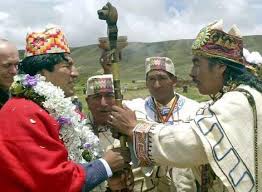
In 2005 he eventually won the presidential election by 54%, which is roughly the share of the indigenous people in the Bolivian population. For the first time since Pizarro's arrival, the heart of South America is ruled by an Aymara. The official inauguration ceremony was in La Paz, where Evo was greeted by thousands of people from the 30+ indigenous ethnicities. But later he made another ceremony at Tiahuanacu, the legendary ancient pre-Inca site at the shores of lake Titicaca. Standing before the Sun Gate there, Morales invoked the spirit of the Andean cosmos and promised to build a better society for the indigenous people. And that implied making fundamental changes to the Constitution.
Following the principles of this specific "Andean socialism", Morales first ensured a state domination of the strategic natural resources of the country - oil and gas, which was the main source of income for the national budget. The money from oil and gas he used to start transforming the social system. Nowadays one could see the "cholitas", the street vendor women being represented in parliament; same for the rural farmers from the remotest corners of the countryside. Their representatives can now be seen sitting in parliament with their typical round hats, braided hair and sandals.

The draft Constitution of Bolivia ensured a doctrine along the lines of a specific Andean "pursuit of happiness", dressed in terms and notions that have been part of the local tradition for many centuries: "Ama qhilla, ama llulla, ama suwa" (Do not be lazy, do not lie, do not steal)... "Teko kavi" (Live well along with the rest), "Nhandereko" (Seek harmony), "Ivi maraei" (A land without evil), and of course "Qhapaj nhan" (The path to wisdom). And these are not just some nice-sounding hollow wishes, those are principles of morality along which generations of indigenous people have lived in the Andes.
The Constitution brought a huge array of changes. Now all public servants are obliged to speak at least one of the indigenous languages. The indigenous communities are allowed to keep some elements of the archaic, even sometimes harsh rules and laws - but only if these do not come into conflict with the universal human rights. And because people in Bolivia believe that Morales was the right guy who could handle the post-colonial legacy, in 2009 he was re-elected with an even bigger margin, 62%.
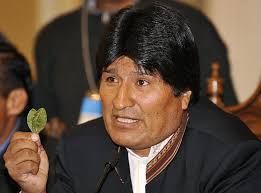
But what about the coca? Well, the president insists that the coca production has always been a central element of the indigenous culture, and it should be one of the symbols of the "new Bolivia". In fact archaeologists have found evidence that the locals had been chewing coca as early as 1200 BC. Today, in rural Bolivia over 90% of the people use coca regularly. Mostly for chewing, but also making tea. It is used in various popular rituals, the businessmen in their skyscrapers in La Paz also appreciate its soothing effect, it has been proven to help against altitude sickness (which is often such a problem in the Andes)... And most hotels throughout the region offer coca leaves to their guests. One could freely buy dried coca at the many markets around town.

Coca grows best in the Bolivian Yungas, the spectacular valleys between the Andes and the Amazonian plains. One would not need to go very far to come across a coca field. Just go to any central square in any village or town, and you would see the street vendors selling the precious leaves. Coca is a tradition, and a source of national pride. The locals claim it helps them work better, be calmer, and socialise with friends, relatives and neighbours. People would often sit together with a bag of coca, chewing the leaves, exchanging one sort for another, discussing its quality... and only then they would come to the point of their conversation. It is like weather talk in Britain, only more fun. Giving a field of coca is the most common wedding gift to the young family.
Yes, cocaine is produced from coca, but first it has to pass through a complex processing to extract the alcaloid from it, using limestone, kerosene, naphtha, sulphuric acid and potassium. Since day one as president, Evo Morales has tried explaining to the world that coca and cocaine are two very different things. Whenever he visits a country, he brings a few coca leaves, even though its importation to America and Europe is strictly prohibited. No doubt he would gladly turn coca into a primary export product for Bolivia if he could. He keeps advertising it as a source of personal "self-knowing" that has been a tradition in the Andes. Last year he even sent his foreign minister to Europe and the UN, to advocate for the legalisation of coca use. "We want to repair a historic injustice", Morales explained. Not surprisingly, the mission of his foreign minister failed. The Europeans would have none of it, and the UN had no intention to remove the anathema on coca.
But other aspects of Morales' policies have every chance of becoming a hit. The Ashaninka people of Peru, the Quechua of Ecuador, the Guarani of Paraguay, and the Yanomami of Brazil have gained more confidence because of his success. They now believe one of theirs could become president some day.
So far, only in Peru the indigenous people have gained no ground politically. And there the reason is historic. In the 80s and 90s, the terrorist organisation Sendero Luminoso (Shining Path) promised to re-build the Inca empire, but with a new Maoist face. Its leader Abimael Guzman was actually a creole, originating from the educated middle class. What he dreamed of was not so much the lost kingdom of Atahualpa, but a form of caveman communism of the Pol Pot model in Cambodia.
300 thousand people died in the ensuing bloody civil war, which was won through dubious methods by almost-dictator Alberto Fujimori (of Japanese origin). Later he was sentenced to 20 years in jail for human rights violations. Ironically, Fujimori and Guzman ended up being neighbours in prison. But the damage had already been done - the civil war discredited the indigenous idea by branding it Marxist. Even today, most Western analysts tend to connect the two. Any indigenous person who would dare oppose the regime, risked being associated with Sendero. That is what happened to the Amazonian Indians who in 2008 went on protests against the corporations that were mercilessly exploiting the natural resources of their rainforest. More than 1000 villages in the rainforest were united behind one Alberto Pizango who was trying to emulate Evo Morales.
70% of the Peruvian rainforest has been rented by various mineral companies. There are mines dotting the landscape everywhere, the environmental devastation has been dramatic. Rare forests and rivers are being privatised. The laws imposed by the government in service of the various corporate interests are threatening the very existence of the indigenous societies, their lifestyle and particularly the "ayllu" principle that is so fundamental for them. Pizango has often said that "an ocean of ignorance" is dividing Peru. In response to his activities, the government has declared him a terrorist, and at some point he was forced to go into exile in Nicaragua. In 2010 he returned to Peru, only to be detained right upon arrival at the airport, but later released. Now he is back into politics, awaiting trial. For the 2011 presidential election he actively advocated that the next Peruvian president should take the indigenous cause to heart, and show more respect for the traditions of the local population. And his prayers may have been heard...
Luis Castaneda Lossio, the mayor of Lima that I mentioned removing the Pizarro statue from its centuries old pedestal, was also running for president. At the first round he got just 10% of the vote. The indigenous people overwhelmingly voted for Ollanta Umala, who is often compared to Hugo Chavez because he is a leftist nationalist, and to Evo Morales because he is actively working for the interests of the indigenous peoples in the Andes and Amazonia.
But the conflict in these societies is not just about who would have control of the natural resources (Morales faced a serious threat of secession in the eastern Bolivian regions, which were economically dominated by the wealthy white elites who were in turn actively supported and sponsored by commercial interests from abroad, including the US). It goes beyond mere economic interests. There are two concepts of life that are colliding here. The cultures of the indigenous peoples against the modern Western technology, the attitude to nature as a living creature that breathes and feels, against nature being solely used as a material tool for self-enrichment. It is no surprise that the indigenous people relate to nature in a very intimate way, they interact with it in a very cautious manner, ever mindful of the consequences of their actions, and the possible backlash they could create if misusing nature for their ends.
Whereas, for international business, the Andes are merely a storage of useful resources, and the Amazon rainforest, in the best case a big source of timber material, or in the worst case a huge thicket that is mostly an obstacle to their safe passage to the illustrious oil and gas fields. "Do not cry for the Amazon, pour more Texaco", an advert says on Ecuadorean TV. No surprise that the whole change started from there.
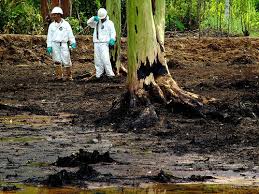
In 2007 the leftist government of Rafael Correa offered a moratorium on the exploitation of oil fields in the Yasuni National park, to protect both the local environment and the living area of the local peoples - under the condition that the international community would find 3.6 billion dollars for compensating the oil industry. But, despite an agreement being reached on the issue, in reality only a fraction of that amount has been paid so far. The authors of the project are naturally disappointed, blaming "extractivism", or the complete dependency on natural resources, for all illnesses in Latin America. They want these nations to abandon the notion of progress equaling a constant stockpiling of material goods and the pursuit of growth for its own sake, at any cost. The main source of this anti-consumerist approach is the indigenous principle for a good living - "Sumak Kawsay" in Quechua, or "Suma Qamanha" in Aymara. In other words, the "happiness economics", which is essentially a harmonious coexistence of humans with nature. And, as hippie as that may sound to any Western cynic, it is actually considered a viable lifestyle in many Latin American societies.
But even there, in the Andes, it is not so easy to turn one's back to materialism completely. Although there has been a noticeable improvement in the recognition of civil and human rights of the indigenous peoples of the region, and their increased participation in political life, meanwhile this has not contributed significantly to curbing rampant poverty and social discrimination. Morales' popularity is steadily dropping. After the gas price hike in the beginning of 2011, there were mass protests in Bolivia. The rural communities started turning against the president, because the reform was going too slowly. He canceled the price hike to calm down his most impatient constituents who were expecting a "good living" sooner rather than later. Granted, after five centuries of exploitation, this could not possibly happen overnight, but people are fed up with poverty and economic marginalisation.
Is it good that in their fight for a better and more just distribution of political and social representation and influence, the indigenous people are insisting to keep their own value system, their own traditions and their inherent lifestyle? Well, not everyone seems to think that the answer should be yes. For example, Nobel laureate in Literature, Mario Vargas Llosa believes that putting the emphasis on ethnic differences and discrepancies is not exactly the best idea. He has said that acts like the symbolic removal of Pizarro's monument and its substitution with "a bogus Inca flag" deserve nothing but ridicule. Not to mention that he attributes to the Incas the gloomier side of his nation's character, but that is another issue. In his essays, he has made many criticisms of indigenous nationalism, and has mockingly called for Lima's mayor to look at his own surname (Castaneda) and come to his senses. Of course, Llosa is himself heir to the Spaniard colonists so his position shouldn't come as a surprise...
But still, he does make some interesting points. Like when he says that the inherited reality of the mixed races should not be dismissed out of hand - it is like rejecting "who we truly are". And this is the reason that many Latin American societies have faced such identity problems. Unlike ones like Brazil, which have gone a different way. Indeed, guys like Mr Mayor wouldn't have existed but for the Conquistadors. The way he dealt with Pizarro's legacy, the renowned author argues, is ultimately a manifestation of a self-loathing on the Mayor's part that reveals a much deeper societal problem than the personal grievances of an individual politician.
But Luis Castaneda isn't impressed by such writings. After all is said and done, that statue now firmly rests in a specially designated park in the suburbs of the old city, half covered by a pedestrian platform, still proudly standing there without its old pedestal. There are even people occasionally laying flowers at its feet. All of them, Hispanic descendants who do not seem to mind the "ethnic differences and discrepancies" that Llosa is so concerned about. And in its place in the centre of Lima, the "bogus" flag of the Inca, the symbol of Tawantisuyu, the lost empire in the Andes, is now flying high, and probably marking a new day for the indigenous peoples of Latin America.

Pizarro left as a legacy a system of rule based on the power of the heirs of the Hispanic conquerors. The end of the Spanish colonial rule may have come 200 years ago, but the system has remained - in many respects, even today. The ancient peoples of Peru, Bolivia and Ecuador have largely remained as poor and deprived of civil rights as before. They continue working in the zinc, silver, lead and gold mines in the Andes, but the ones making wealth from this industry are the tiny post-colonial elites. Exclusively of Hispanic descent.
In the 20s of the last century, the
Ever since 1825 when it gained its independence with blood and sweat, Bolivia has been ruled by mining moguls, the military elites and various oligarchs. All social revolutions have failed, because even the Marxists had ignored the cause of the local peoples, and pursued their agendas that were alien to the local people. The Bolivian society remained split into creoles (the heirs of the European settlers) and the indigenous majority, who have preserved the legacy of the ancient civilisations. Most people in the Andes speak Quechua, a language directly descended from the Incas. And in Bolivia, another related language is wide spread, Aymara.
The most elementary form of social organisation in Bolivia is called "ayllu", and it actually predates the Inca civilisation. It is a form of cooperative commune. Land is for common use, in contrast to the land policies of the colonial elites, who have tried to destroy the rural communities through population transfers from one area to another. The Andean villagers have resisted this with all means.
Under the ostensible mantle of Catholicism, most old religious customs have preserved. The Andean gods remain as revered and powerful as ever, only in a different form. Like Pachamama, the Mother Earth, who has become Mother Mary. Or Ekeko, the god of good luck. Even today, before building a house, the local people would bury the ashes of a sacrificed llama near the place. The main source of medical care in the Andes are still the various shamans. Even the count of time is cyclical. The linear notion of time that is so typical for the industrialised world, is alien to the indigenous people. The traditions are very alive and well indeed.
After 2000, a new popular democratic movement has arisen in the rural communities in Bolivia. We in the West might hasten to call it "communism", or "socialism", or any other sort of "ism"... but it is not exactly that. It is a specifically Andean phenomenon. And it has even manifested itself through the election of a new type of leader, one who became the first president of indigenous origin. The political ascent of Evo Morales was anything but easy, or ordinary. He is Aymara, born in a village in the cold harsh Altiplano plateau. He grew up in poverty, his family lived in a clay hut. He was looking for the llamas, making ends meet by playing music on weddings and festivals, and growing coca, the traditional crop of the region. Then he became a leader of the local union, then a member of parliament. He gradually managed to mobilise the indigenous majority amidst all the political chaos caused by his neo-liberal predecessors.
In 2005 he eventually won the presidential election by 54%, which is roughly the share of the indigenous people in the Bolivian population. For the first time since Pizarro's arrival, the heart of South America is ruled by an Aymara. The official inauguration ceremony was in La Paz, where Evo was greeted by thousands of people from the 30+ indigenous ethnicities. But later he made another ceremony at Tiahuanacu, the legendary ancient pre-Inca site at the shores of lake Titicaca. Standing before the Sun Gate there, Morales invoked the spirit of the Andean cosmos and promised to build a better society for the indigenous people. And that implied making fundamental changes to the Constitution.
Following the principles of this specific "Andean socialism", Morales first ensured a state domination of the strategic natural resources of the country - oil and gas, which was the main source of income for the national budget. The money from oil and gas he used to start transforming the social system. Nowadays one could see the "cholitas", the street vendor women being represented in parliament; same for the rural farmers from the remotest corners of the countryside. Their representatives can now be seen sitting in parliament with their typical round hats, braided hair and sandals.
The draft Constitution of Bolivia ensured a doctrine along the lines of a specific Andean "pursuit of happiness", dressed in terms and notions that have been part of the local tradition for many centuries: "Ama qhilla, ama llulla, ama suwa" (Do not be lazy, do not lie, do not steal)... "Teko kavi" (Live well along with the rest), "Nhandereko" (Seek harmony), "Ivi maraei" (A land without evil), and of course "Qhapaj nhan" (The path to wisdom). And these are not just some nice-sounding hollow wishes, those are principles of morality along which generations of indigenous people have lived in the Andes.
The Constitution brought a huge array of changes. Now all public servants are obliged to speak at least one of the indigenous languages. The indigenous communities are allowed to keep some elements of the archaic, even sometimes harsh rules and laws - but only if these do not come into conflict with the universal human rights. And because people in Bolivia believe that Morales was the right guy who could handle the post-colonial legacy, in 2009 he was re-elected with an even bigger margin, 62%.
But what about the coca? Well, the president insists that the coca production has always been a central element of the indigenous culture, and it should be one of the symbols of the "new Bolivia". In fact archaeologists have found evidence that the locals had been chewing coca as early as 1200 BC. Today, in rural Bolivia over 90% of the people use coca regularly. Mostly for chewing, but also making tea. It is used in various popular rituals, the businessmen in their skyscrapers in La Paz also appreciate its soothing effect, it has been proven to help against altitude sickness (which is often such a problem in the Andes)... And most hotels throughout the region offer coca leaves to their guests. One could freely buy dried coca at the many markets around town.
Coca grows best in the Bolivian Yungas, the spectacular valleys between the Andes and the Amazonian plains. One would not need to go very far to come across a coca field. Just go to any central square in any village or town, and you would see the street vendors selling the precious leaves. Coca is a tradition, and a source of national pride. The locals claim it helps them work better, be calmer, and socialise with friends, relatives and neighbours. People would often sit together with a bag of coca, chewing the leaves, exchanging one sort for another, discussing its quality... and only then they would come to the point of their conversation. It is like weather talk in Britain, only more fun. Giving a field of coca is the most common wedding gift to the young family.
Yes, cocaine is produced from coca, but first it has to pass through a complex processing to extract the alcaloid from it, using limestone, kerosene, naphtha, sulphuric acid and potassium. Since day one as president, Evo Morales has tried explaining to the world that coca and cocaine are two very different things. Whenever he visits a country, he brings a few coca leaves, even though its importation to America and Europe is strictly prohibited. No doubt he would gladly turn coca into a primary export product for Bolivia if he could. He keeps advertising it as a source of personal "self-knowing" that has been a tradition in the Andes. Last year he even sent his foreign minister to Europe and the UN, to advocate for the legalisation of coca use. "We want to repair a historic injustice", Morales explained. Not surprisingly, the mission of his foreign minister failed. The Europeans would have none of it, and the UN had no intention to remove the anathema on coca.
But other aspects of Morales' policies have every chance of becoming a hit. The Ashaninka people of Peru, the Quechua of Ecuador, the Guarani of Paraguay, and the Yanomami of Brazil have gained more confidence because of his success. They now believe one of theirs could become president some day.
So far, only in Peru the indigenous people have gained no ground politically. And there the reason is historic. In the 80s and 90s, the terrorist organisation Sendero Luminoso (Shining Path) promised to re-build the Inca empire, but with a new Maoist face. Its leader Abimael Guzman was actually a creole, originating from the educated middle class. What he dreamed of was not so much the lost kingdom of Atahualpa, but a form of caveman communism of the Pol Pot model in Cambodia.
300 thousand people died in the ensuing bloody civil war, which was won through dubious methods by almost-dictator Alberto Fujimori (of Japanese origin). Later he was sentenced to 20 years in jail for human rights violations. Ironically, Fujimori and Guzman ended up being neighbours in prison. But the damage had already been done - the civil war discredited the indigenous idea by branding it Marxist. Even today, most Western analysts tend to connect the two. Any indigenous person who would dare oppose the regime, risked being associated with Sendero. That is what happened to the Amazonian Indians who in 2008 went on protests against the corporations that were mercilessly exploiting the natural resources of their rainforest. More than 1000 villages in the rainforest were united behind one Alberto Pizango who was trying to emulate Evo Morales.
70% of the Peruvian rainforest has been rented by various mineral companies. There are mines dotting the landscape everywhere, the environmental devastation has been dramatic. Rare forests and rivers are being privatised. The laws imposed by the government in service of the various corporate interests are threatening the very existence of the indigenous societies, their lifestyle and particularly the "ayllu" principle that is so fundamental for them. Pizango has often said that "an ocean of ignorance" is dividing Peru. In response to his activities, the government has declared him a terrorist, and at some point he was forced to go into exile in Nicaragua. In 2010 he returned to Peru, only to be detained right upon arrival at the airport, but later released. Now he is back into politics, awaiting trial. For the 2011 presidential election he actively advocated that the next Peruvian president should take the indigenous cause to heart, and show more respect for the traditions of the local population. And his prayers may have been heard...
Luis Castaneda Lossio, the mayor of Lima that I mentioned removing the Pizarro statue from its centuries old pedestal, was also running for president. At the first round he got just 10% of the vote. The indigenous people overwhelmingly voted for Ollanta Umala, who is often compared to Hugo Chavez because he is a leftist nationalist, and to Evo Morales because he is actively working for the interests of the indigenous peoples in the Andes and Amazonia.
But the conflict in these societies is not just about who would have control of the natural resources (Morales faced a serious threat of secession in the eastern Bolivian regions, which were economically dominated by the wealthy white elites who were in turn actively supported and sponsored by commercial interests from abroad, including the US). It goes beyond mere economic interests. There are two concepts of life that are colliding here. The cultures of the indigenous peoples against the modern Western technology, the attitude to nature as a living creature that breathes and feels, against nature being solely used as a material tool for self-enrichment. It is no surprise that the indigenous people relate to nature in a very intimate way, they interact with it in a very cautious manner, ever mindful of the consequences of their actions, and the possible backlash they could create if misusing nature for their ends.
Whereas, for international business, the Andes are merely a storage of useful resources, and the Amazon rainforest, in the best case a big source of timber material, or in the worst case a huge thicket that is mostly an obstacle to their safe passage to the illustrious oil and gas fields. "Do not cry for the Amazon, pour more Texaco", an advert says on Ecuadorean TV. No surprise that the whole change started from there.
In 2007 the leftist government of Rafael Correa offered a moratorium on the exploitation of oil fields in the Yasuni National park, to protect both the local environment and the living area of the local peoples - under the condition that the international community would find 3.6 billion dollars for compensating the oil industry. But, despite an agreement being reached on the issue, in reality only a fraction of that amount has been paid so far. The authors of the project are naturally disappointed, blaming "extractivism", or the complete dependency on natural resources, for all illnesses in Latin America. They want these nations to abandon the notion of progress equaling a constant stockpiling of material goods and the pursuit of growth for its own sake, at any cost. The main source of this anti-consumerist approach is the indigenous principle for a good living - "Sumak Kawsay" in Quechua, or "Suma Qamanha" in Aymara. In other words, the "happiness economics", which is essentially a harmonious coexistence of humans with nature. And, as hippie as that may sound to any Western cynic, it is actually considered a viable lifestyle in many Latin American societies.
But even there, in the Andes, it is not so easy to turn one's back to materialism completely. Although there has been a noticeable improvement in the recognition of civil and human rights of the indigenous peoples of the region, and their increased participation in political life, meanwhile this has not contributed significantly to curbing rampant poverty and social discrimination. Morales' popularity is steadily dropping. After the gas price hike in the beginning of 2011, there were mass protests in Bolivia. The rural communities started turning against the president, because the reform was going too slowly. He canceled the price hike to calm down his most impatient constituents who were expecting a "good living" sooner rather than later. Granted, after five centuries of exploitation, this could not possibly happen overnight, but people are fed up with poverty and economic marginalisation.
Is it good that in their fight for a better and more just distribution of political and social representation and influence, the indigenous people are insisting to keep their own value system, their own traditions and their inherent lifestyle? Well, not everyone seems to think that the answer should be yes. For example, Nobel laureate in Literature, Mario Vargas Llosa believes that putting the emphasis on ethnic differences and discrepancies is not exactly the best idea. He has said that acts like the symbolic removal of Pizarro's monument and its substitution with "a bogus Inca flag" deserve nothing but ridicule. Not to mention that he attributes to the Incas the gloomier side of his nation's character, but that is another issue. In his essays, he has made many criticisms of indigenous nationalism, and has mockingly called for Lima's mayor to look at his own surname (Castaneda) and come to his senses. Of course, Llosa is himself heir to the Spaniard colonists so his position shouldn't come as a surprise...
But still, he does make some interesting points. Like when he says that the inherited reality of the mixed races should not be dismissed out of hand - it is like rejecting "who we truly are". And this is the reason that many Latin American societies have faced such identity problems. Unlike ones like Brazil, which have gone a different way. Indeed, guys like Mr Mayor wouldn't have existed but for the Conquistadors. The way he dealt with Pizarro's legacy, the renowned author argues, is ultimately a manifestation of a self-loathing on the Mayor's part that reveals a much deeper societal problem than the personal grievances of an individual politician.
But Luis Castaneda isn't impressed by such writings. After all is said and done, that statue now firmly rests in a specially designated park in the suburbs of the old city, half covered by a pedestrian platform, still proudly standing there without its old pedestal. There are even people occasionally laying flowers at its feet. All of them, Hispanic descendants who do not seem to mind the "ethnic differences and discrepancies" that Llosa is so concerned about. And in its place in the centre of Lima, the "bogus" flag of the Inca, the symbol of Tawantisuyu, the lost empire in the Andes, is now flying high, and probably marking a new day for the indigenous peoples of Latin America.


(no subject)
Date: 4/11/12 19:41 (UTC)So Bravo Evo, keep it going. *two thumbs up*
(no subject)
Date: 4/11/12 20:03 (UTC)The existing cap & trade system is a huge global business spanning all continents and bringing serious profits to the accredited agencies (almost exclusively based in the First World), while effectively giving the big industrial powers ground for excuse under the pretense of doing good for poor economies by outsourcing their production (and hence, their pollution) overseas, and "creating jobs" in return. In fact, countries like Germany and Canada who are constantly bragging about being the most "environmentally friendly" in the world, are only able to meet the ecological standards because most of their highly environmentally demanding production is already outsourced to countries of the Third World, including Latin America.
(no subject)
Date: 4/11/12 20:07 (UTC)So once again, Bravo Evo!
(no subject)
Date: 4/11/12 20:12 (UTC)Which brings us back to the new monthly topic. =)
(no subject)
Date: 4/11/12 20:24 (UTC)(no subject)
From:(no subject)
Date: 4/11/12 20:16 (UTC)Oh, but I'm sure the answer would be, "They're just private businesses, they have nothing to do with our country and its policies". Blablabla. As if the foreign policies of any country do not try to promote said country's business interests. I don't know if anyone with at least two brain cells is buying that crap, even though some may like to pretend that they do.
(no subject)
Date: 4/11/12 20:26 (UTC)(no subject)
Date: 4/11/12 22:19 (UTC)Isn't that a strawman too? Nobody claims such a thing. Evo Morales is not restoring the Inca empire in any shape or form. He's advocating the use of indigenous traditions in shaping the local societies, as opposed to imposing foreign models from abroad for the benefit of international economic interests. That he uses symbols that belonged to the Inca empire is an indication of his intention to use those traditions, not that he's recreating Tawantisuyu for the sake of substituting one form of colonialism with another.
(no subject)
Date: 4/11/12 22:29 (UTC)Morales is less the inheritor of the Incas or Native American traditions in one sense and more one of those rare, genuine, reforming Caudillos of the Porofirio Diaz variety who is actually making things better. That Morales is a genuine reformer is the basic difference between Bolivia and Peru or Venezuela, where the leaders are primarily self-interested and any changes they make are about ensuring their supporters' backs are scratched and that their supporters scratch their own back.
To assuming that the statement about the Incas, which you deleted a vital part of the context with (which is adding quote mining to the strawman) was anything but noting something was ironic. The statements about Morales, which I was hoping would get the response, were entirely ignored to focus on one part of one sentence.
The full statement was this: However it's worth noting that there is a decided irony in calling the Tawantinsuyu/Inca state anti-colonial or anti-imperial. It was just the empire that preceded Pizarro's and had its own track record of shuffling peoples around all over the place
In English, however is a word that indicates transition in a sentence. The sentence after it notes the irony in the descendants of one empire applauding the removal of the symbology of another, and ended there to go to the next sentences, which followed it and noted that Morales is not in fact referencing the Incas but he's the rare genuine former, who as noted later in the comment is actually getting results. So, simply put, I'm not the one using the strawman argument here.
(no subject)
Date: 4/11/12 22:42 (UTC)(no subject)
Date: 4/11/12 22:49 (UTC)(no subject)
From:(no subject)
From:(no subject)
From:(no subject)
From:(no subject)
From:(no subject)
From:(no subject)
From:(no subject)
From:(no subject)
From:(no subject)
From:(no subject)
From:(no subject)
From:(no subject)
From:(no subject)
From:(no subject)
From:(no subject)
From:(no subject)
From:(no subject)
Date: 4/11/12 22:46 (UTC)?!?
My head is spinning so fast now, you could use it as a fan!
(no subject)
From:(no subject)
From:(no subject)
From:(no subject)
From:(no subject)
From:(no subject)
From:(no subject)
From:(no subject)
From:(no subject)
From:(no subject)
From:(no subject)
From:(no subject)
From:(no subject)
From:(no subject)
From:(no subject)
From:(no subject)
From:(no subject)
Date: 4/11/12 19:47 (UTC)(Runs back for chips and some beer and a pillow to seat myself comfortably).
(no subject)
Date: 4/11/12 21:05 (UTC)(no subject)
Date: 4/11/12 22:26 (UTC)Believe me, anything other than British weather talk is more fun.
(no subject)
Date: 4/11/12 22:37 (UTC)(no subject)
Date: 4/11/12 22:39 (UTC)(no subject)
Date: 4/11/12 22:53 (UTC)(no subject)
From:(no subject)
From:(no subject)
From:(no subject)
From:(no subject)
From:(no subject)
From:(no subject)
From:(no subject)
From:(no subject)
From:(no subject)
Date: 5/11/12 01:15 (UTC)Sadly, I couldn't find a link to my fave bit of Morales fandom, a Mexican band's song called (translated from Spanish, of course) "Find Him Another Sweater." The word "feo" appears enough to get the thought across.
(no subject)
Date: 5/11/12 19:06 (UTC)Of course, many Christians today would claim that Pizarro was not really a Christian but a Roman Catholic.
I know a guy who studied native shamanism in Peru. He puts on pretty cool ritual shows.
(no subject)
Date: 6/11/12 15:17 (UTC)(no subject)
Date: 6/11/12 16:32 (UTC)(no subject)
Date: 6/11/12 16:37 (UTC)Cool fact: mojo is from Hoodo .
(no subject)
From:(no subject)
From:(no subject)
From:(no subject)
From:(no subject)
From:(no subject)
From:(no subject)
Date: 6/11/12 17:54 (UTC)(no subject)
From:(no subject)
From:(no subject)
From:(no subject)
Date: 6/11/12 18:10 (UTC)(no subject)
From: