![[identity profile]](https://www.dreamwidth.org/img/silk/identity/openid.png) sophia-sadek.livejournal.com posting in
sophia-sadek.livejournal.com posting in ![[community profile]](https://www.dreamwidth.org/img/silk/identity/community.png) talkpolitics
talkpoliticsChildren attending middle school today have no direct experience of the events that led to the quagmire in Afghanistan. Likewise, they have no experience of the pre-9/11 world. They have grown up in a time and place that bears the imprint of that tragic act of war and all of the knee-jerk stupidity that followed in its wake.
A comparable event for people of my generation might be the construction of the Berlin Wall or, better, the Cuban Missile Crisis. It was an event that left a lasting impression on the adults and older children of our youth. Its trauma was tangible given that it was the closest the US and USSR got to a full blown exchange of nuclear munitions. The fear left a mark on those who lived it while the youngest of us picked up on it in a second-hand fashion. It seemed as if the world was always that way just as today's middle school students know nothing of life before Homeland Security and the Patriot Act.
The collapse of the Soviet Union has made it possible for us to get a glimpse of the machinations behind the scenes in Moscow. A. A. Fursenko and Timothy Naftali published a joint study of the event as an East/West collaboration. The work includes the impression that IRBM (intermediate range ballistic missile) deployment by US/UK/NATO in England, Italy, and Turkey made on Soviet leaders. These missiles were brought up in the negotiations over withdrawal of Soviet MRBs and IRBMs from Cuba. Another historian, Philip Nash, has published an account of these other missiles and President Kennedy's secret agreement to dismantle them.
The event left us with expressions such as being eyeball to eyeball when the other guy blinked as well as an eloquent description of a rope upon which the knot of war is tied. Dean Rusk, the American Secretary of State at the time, describes the origin of the "eyeball to eyeball" remark in his personal memoir.
Kennedy came away from the event with mixed reviews. He was seen as a strong leader in the eyes of some and a spineless wimp in the eyes of others. Although Kennedy achieved the withdrawal of Soviet IRBMs from Cuba, he promised in return not to invade Cuba and to dismantle American IRBMs. This did not sit well with hard line anti-Communists at the time. Although the removal of the missiles occurred months later, their removal was suspected as a concession to the Soviets. It turned out to be an accurate suspicion since Kennedy's promise to Khrushchev included a removal time frame that was adhered to.

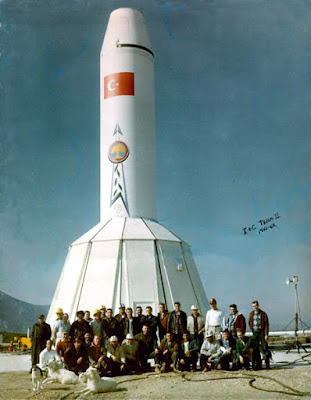
Here is an image of one of the American missiles in Turkey from Philip Nash's book and an image from the Internet. (The nuclear explosive nosecone is missing on the second photo.)
Do you have any observations on US/Soviet/Cuban relations to mark this 50th anniversary of the Missile Crisis? Are there any lessons from that event that political leaders today can learn from?
Links: Fursenko and Naftali's book, One Hell of a Gamble. Philip Nash's book, The Other Missiles of October. Khrushchev's "knot of war" letter. Dean Rusk's memoir, As I Saw It.
A comparable event for people of my generation might be the construction of the Berlin Wall or, better, the Cuban Missile Crisis. It was an event that left a lasting impression on the adults and older children of our youth. Its trauma was tangible given that it was the closest the US and USSR got to a full blown exchange of nuclear munitions. The fear left a mark on those who lived it while the youngest of us picked up on it in a second-hand fashion. It seemed as if the world was always that way just as today's middle school students know nothing of life before Homeland Security and the Patriot Act.
The collapse of the Soviet Union has made it possible for us to get a glimpse of the machinations behind the scenes in Moscow. A. A. Fursenko and Timothy Naftali published a joint study of the event as an East/West collaboration. The work includes the impression that IRBM (intermediate range ballistic missile) deployment by US/UK/NATO in England, Italy, and Turkey made on Soviet leaders. These missiles were brought up in the negotiations over withdrawal of Soviet MRBs and IRBMs from Cuba. Another historian, Philip Nash, has published an account of these other missiles and President Kennedy's secret agreement to dismantle them.
The event left us with expressions such as being eyeball to eyeball when the other guy blinked as well as an eloquent description of a rope upon which the knot of war is tied. Dean Rusk, the American Secretary of State at the time, describes the origin of the "eyeball to eyeball" remark in his personal memoir.
Kennedy came away from the event with mixed reviews. He was seen as a strong leader in the eyes of some and a spineless wimp in the eyes of others. Although Kennedy achieved the withdrawal of Soviet IRBMs from Cuba, he promised in return not to invade Cuba and to dismantle American IRBMs. This did not sit well with hard line anti-Communists at the time. Although the removal of the missiles occurred months later, their removal was suspected as a concession to the Soviets. It turned out to be an accurate suspicion since Kennedy's promise to Khrushchev included a removal time frame that was adhered to.
Here is an image of one of the American missiles in Turkey from Philip Nash's book and an image from the Internet. (The nuclear explosive nosecone is missing on the second photo.)
Do you have any observations on US/Soviet/Cuban relations to mark this 50th anniversary of the Missile Crisis? Are there any lessons from that event that political leaders today can learn from?
Links: Fursenko and Naftali's book, One Hell of a Gamble. Philip Nash's book, The Other Missiles of October. Khrushchev's "knot of war" letter. Dean Rusk's memoir, As I Saw It.


(no subject)
Date: 23/10/12 15:22 (UTC)In the strategic retrospective, I believe Khrushjov played his part well: he both secured Cuba from US invasion AND got the American missiles removed from Turkey.
On the other hand, it has to be admitted that the crisis, paradoxically, led to 'better' relations between two superpowers - i mean the understanding of each other's motivation, way of thinking and decision making processes improved.
'Special thanks to informal contacts.'
In this sense, Khrushev and Kennedy paved the way for Noxon-Brezhnev and emergence of 'arms control'
PS. Cuban missile crisis belongs to the same epogue with the U2 downing, Berlin wall crisis, Vietnam war etc - it was time pretty well packed with notable events.
(no subject)
Date: 23/10/12 15:33 (UTC)As for the informal contacts, Fursenko and Naftali mention the role of a Russian emigre bar tender in alerting the Soviets of the seriousness of American military plans.
Gary Powers tells an interesting story of his experience of being shot down in a U2 over Sverdlovsk, imprisoned, interrogated, and tried. It is a fascinating look into post-Stalin Lubyanka.
(no subject)
Date: 23/10/12 15:45 (UTC)(no subject)
Date: 23/10/12 15:48 (UTC)(no subject)
Date: 23/10/12 15:51 (UTC)(no subject)
From:(no subject)
From:(no subject)
From:(no subject)
From:(no subject)
Date: 23/10/12 15:55 (UTC)(no subject)
Date: 23/10/12 16:05 (UTC)(no subject)
From:(no subject)
Date: 23/10/12 15:29 (UTC)Robert McNamara, the Secretary of Defense, was the subject of a documentary The Fog of War, highly recommended to watch.
Subsequent revelations from former Soviet officials and their American counterparts, along with Fidel Castro show how much much closer than anyone previously thought. (http://en.wikipedia.org/wiki/Cuban_Missile_Crisis) cf: "Post-Crisis Revelations." And according to these new revelations, Khrushchev wanted New York City as one of the primary targets for those missiles in Cuba.
(no subject)
Date: 23/10/12 15:37 (UTC)Fursenko and Naftali mention an exchange between Castro and a Soviet official where Castro actually favored the Soviets launching a nuclear attack on the US. It gave him a reputation as a hot-head with the Soviets. Castro came out the loser in the whole affair despite the promise on the part of Kennedy to not invade.
(no subject)
Date: 23/10/12 15:44 (UTC)(no subject)
Date: 23/10/12 15:46 (UTC)(no subject)
From:(no subject)
Date: 23/10/12 15:54 (UTC)(no subject)
Date: 23/10/12 16:01 (UTC)(no subject)
From:(no subject)
From:(no subject)
From:(no subject)
From:(no subject)
From:(no subject)
From:(no subject)
From:(no subject)
From:(no subject)
From:(no subject)
From:(no subject)
From:(no subject)
From:(no subject)
From:(no subject)
From:(no subject)
From:(no subject)
From:(no subject)
From:(no subject)
From:(no subject)
From:(no subject)
From:(no subject)
From:(no subject)
From:(no subject)
Date: 23/10/12 16:17 (UTC)(no subject)
Date: 23/10/12 16:19 (UTC)(no subject)
Date: 23/10/12 15:47 (UTC)That Kennedy did not know the extent of the US nuclear arsenal at the time is not a surprise, he, after all, ran on a missile gap that never was and used that kind of fearmongering to make people in the USA frightened of the USSR more than they should have been. It was in the 1970s and 1980s that it actually *did* have a missile gap in its favor. Not the 1960s, which is the reason that no nuclear war happened over this incident.
(no subject)
Date: 23/10/12 15:56 (UTC)Kennedy was fully aware that the missile gap was smoke and mirrors once he got into office. McNamara made the faux pas of admitting as much in a press conference during his first weeks on the job.
(no subject)
Date: 23/10/12 16:00 (UTC)You realize that in noting that McNamara simply made it clear that the Kennedy Administration was the Democratic version of the Bush Administration, namely idealistic, reliant on blatant lies to secure power, and having no fundamental comprehension of how geopolitics works in the real world?
(no subject)
Date: 23/10/12 16:31 (UTC)(no subject)
From:(no subject)
From:(no subject)
From:(no subject)
From:(no subject)
From:(no subject)
From:(no subject)
From:(no subject)
From:(no subject)
From:(no subject)
From:(no subject)
From:(no subject)
From:(no subject)
From:(no subject)
From:(no subject)
From:(no subject)
Date: 23/10/12 17:24 (UTC)(no subject)
Date: 25/10/12 17:08 (UTC)(no subject)
Date: 23/10/12 18:07 (UTC)(no subject)
Date: 23/10/12 20:24 (UTC)(no subject)
Date: 24/10/12 02:23 (UTC)(no subject)
Date: 24/10/12 15:16 (UTC)blockadequarantine would be safer and (hopefully) more effective. After all, there is the concept of "use it or lose it" where military operations could precipitate a launch rather than deter it.(no subject)
From:(no subject)
From:(no subject)
From:(no subject)
From:(no subject)
From: