![[identity profile]](https://www.dreamwidth.org/img/silk/identity/openid.png) mahnmut.livejournal.com posting in
mahnmut.livejournal.com posting in ![[community profile]](https://www.dreamwidth.org/img/silk/identity/community.png) talkpolitics
talkpoliticsAll right then, we're to talk about the future developments in the world? Fine. Let's begin with a recent G8 meeting in Camp David, where Putin did the remarkable gesture to... well, quit the meeting. He sent his puppet Medvedev in his stead. This may or may not call associations with the old Cold War times and all the passive-aggressive RL-trolling that was so inherent to that epoch, but one thing is for sure: the message he's trying to send is, "Look at us, we're Russia, we're strong and we do whatever we like, so deal with it". Or something like that.
Did it have an effect? I dunno, probably not a real one, but maybe symbolic. Because Obama soon responded by quitting his participation at the APEC-2012 meeting in Vladivostok. So where are we headed now?...
Not so long ago, another nice meeting took place in New Delhi, this time of the BRICS countries. The finance ministers who represented the big fivegame species emerging economies came up with a resolution that's supposed to send a loud signal to the financial markets. What does it say? That the current global currency (namely: King Dollar), is shaking. OMGZ! Well, sure. The dollar is at an all-times low, etc. And more importantly, the BRICS ministers took "an historic" decision to move further away from it and start doing their transactions in their respective national currencies.

How big is this? Well, let's look at the tendencies. The five BRIC+S economies now make up for roughly 2/3 of today's global economy. So,if when this decision is put to practice, there'll be thunders and lightnings on Wall Street. Actually when you think of it, Wall Street may stop being so relevant after all. Too bold a prediction? I say let's not write it off so fast, OK?
Also, it's possible that this new bloc would go beyond being just an economic group, and would expand their political cooperation and make it military-defensive cooperation. Let me hypothesize here a bit. I'd say that alliance won't exactly rest upon the same platform like NATO. Despite their scattered geographic position, the BRICS countries seem to have the political will to go down the path of broadening their political cooperation. And that means becoming a big rival to American/European domination.
Of course all five are already serious regional powers in their own worth, and not just economically but also militarily. And it's not like this tendency is new. The old mono-polar world (that's lead us to such horrible unilateral adventures like Iraq and Afghanistan that've cost thousands of lives), is going fast into oblivion. When I say "fast", I do mean it's happening within a matter of decades. It's no longer unreasonable to project a bit further into the future and see how the elite club of the former and current imperial powers who've been ruling the planet for centuries, are lagging further behind and losing positions. Some are still fighting and kicking, and doing silly things in their desperation to preserve their dominance, but their effort is ultimately doomed. There are natural factors at play. With their economic superiority waning, this model cannot go on forever. As it stands, history teaches us that every empire, no matter how powerful and huge, sooner or later sees the day when "the Sun sets over it", contrary to the old adage about the British Empire. Even the most ambitious architects of neo-empires know that, because the seed of decline and/or collapse is always buried within the very fabric of their success.
The twilight of the neo-imperialist, unilateralist, preemptivist philosophy could well lead to a re-thinking of the geopolitical approach on a global scale, and lead to a multi-polar world. I'm not saying it'll be better than the current one, but there it is. Mind you, chances are it could be worse. But in reality, as soon as that model is seen as a viable alternative, more will want to join. We can't rule out the possible creation of multiple blocs of loose connections, rivaling each other. All of this might've sounded like the paranoid fantasizing of an alternate history wacko just a few decades ago, or why not the desperate pipe dream of a Third World revolutionary who's utterly disillusioned with the "yoke under the master's boot". But not any more. We're talking of the place where reality seems to be headed now, a tendency that's gradually becoming more visible with every next year. And everybody involved better be prepared for it, in whatever ways they can.
Just have a look at Europe. It's experiencing turbulent times unseen since the world wars. Mostly "thanks" to the politics of some economic and political circles. Those who carried the storm over the Atlantic were the big investment bank(st)ers from New York and London, who prescribed the wrong economic recipe. Or maybe they did something wrong in implementing the already existing one, after the hard lesson with the burst of the mortgage balloon and all those credits that became worthless pieces of paper almost overnight. Along with the investment bankers, the other contributor for this mess was the IMF with its inadequate decisions that often gave the exact opposite results to the intended ones, after pouring imaginary money onto problems that couldn't possibly be solved through... well, sheer money-pouring (reference: Greece). And over-spending governments gone crazy with creating a living standard that could not be possibly sustained in the long run. Entire societies gone drunk, and even when faced with the abyss, demanding for more, and expecting that things return to what they used to be before the shit hit the fan. Incredible naivety and self delusion.
Severe austerity measures were adopted by some of these countries, carried at the tip of a spear, or rather police batons. Those who'll be paying the bulk of the bill, will of course be... the middle class, now hurting badly and sliding down the slope to misery, while the tiny elites of the wealthiest are drowning in unprecedented prosperity. The gap is growing at an alarming speed and reaching staggering proportions, and we all know what extreme social disparity inevitably leads to: chaos and turmoil, anarchy and revolution. And blood. Europe isn't new to these things, but what about America? The slap across the face of a society that's inexperienced in strife and turmoil, could produce some mind-blowing results, I'm sure you'd agree. The most recent example is of course again Greece, which now finds itself in a historic situation where it's hanging at the precipice between staying in the Eurozone and becoming "slave to the international banksters" -or- leaving the Eurozone and becoming an isolated Third World banana republic.
And it's not just Greece. You'd wish it was. But there are also Spain, Portugal and Italy, looking anxiously at the events, and facing similar, if not even bigger problems. Spain already made a slide further down the slope these days. The recession index in the UK is now in the double digits. A fact the British authorities were trying to deny for a long time, but were finally compelled to admit very recently. Hollande's France is claiming to be back on the development road rather than the road to harakiri and squeezed belts (as apparently demanded by the IMF, Germany and the bankers), but where to take the money for all that? Yes, you guessed right. Still more debt, and the vicious cycle keeps on keeping on. It's all a lose-lose situation.
So, all that said, I'd argue we're possibly just a couple of steps away from the inevitable. The Euro as we know it, will cease to exist. And the same is valid for the dollar in the longer run. And many might now ask, so what next? By the looks of it and the way things are headed, are we to see the end of Western hegemony, be it economic, political and even military? Would the old superpowers and the old alliances slide into history? I don't know, will they? Maybe, or maybe not completely. Maybe they'll transform. Or maybe some sudden event will snap and send the domino effect rolling. We can't know. But what's for sure is, things won't remain the same. They just can't.
And, while we're about globalization, may I say that in a way, it has already achieved some of its goals. It's made the world smaller, especially for some particular segments. The world of business was the one that benefited the most from globalization, creating new trade corridors - something that allowed it to gain access to almost every corner of the world. So far, so good. The "globalization" phenomenon mostly stimulated mass consumption, but did it bring a profound social and economic benefit to the bulk of society? I'd argue: not really. Now, with the inevitable changes looming on the economic horizon in the former great powers, and the possible collapse of the world's two main currencies, the old models are bound to become a page in the history books pretty soon.
Of course this doesn't mean that various immitations of globalization won't keep popping up here and there. Various trading blocs of groups of countries will continue to exist in Latin America, Asia and Africa, and of course Europe. This will result in the further marginalization of Europe and the US, making them just two among the many players rather than total hegemons; and that would contribute to changing the future map of the world. For example the countries in Central and South America are now giving a clear sign that they no longer feel obliged to constantly depend on US aid for their industry, trade, security, or any other aspect of their development.
It's already a fact that the major local economies like Brazil, Argentina, Venezuela, joined by some lesser economies like Bolivia and Nicaragua to name a few, now dare go in a direction that's different from the established one. Possibly one that would further unite them in their attempt to protect themselves from the US dictate and the notion that "this is the US backyard, period". These economies are recovering and developing, focusing more on the social and economic well-being of their own people, sometimes doing mistakes out of inexperience or due to getting carried away, sometimes paying a steep price for it... But, unlike many episodes in the past when despotic politicians installed by foreign powers would rule with an iron fist against the interests of the populace, while serving foreign (often private, corporate) interests, the bulk of them are now trying to formulate their own agendas and pursue their own interests.
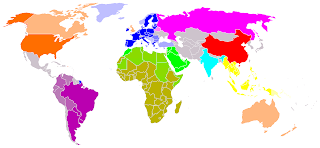
Just to summarize, the new world map that was being formed by the (former?) great powers, mostly the US and Europe, seems to be transforming into something new. Is it scary? Not sure. But it'll be a newer "New World Order". Is my hope that it'll be an order of more justice, more equality and more cooperation between nations, just a naive pipe dream? I'm usually sceptical and I'd say yes it is, because there are innumerable little ways things could go wrong. But I for one would love to see a world where cooperation is more preferred than it is now, as opposed to the terms of the game being dictated by few juggernauts from the position of power, where directives are being imposed, and where the smaller players don't matter. A world where terrorism is seen as a viable reaction to the pressure from the great powers who don't want to listen and who are not prone to negotiating their positions - this is where we are now, and I'm not liking it. Let's hope the next generation will see a different picture. The risks are many, and it could end up being a much worse place, but change is inevitable. The mono-polar world is unsustainable, it's mostly a transitional stage from one end product (Cold War era) to another (whatever follows next).
So the power and role of this mono-polar world is very likely to shrink to unrecognizable proportions, in result from the disillusion and/or desperation as a product and a result from the crisis - a crisis that's not just economic but most of all social, and which, again, traces its roots in the Western model. That role will shrink, possibly to give way to a much more politically diverse world, hopefully one of equals rather than masters and subordinates. A world where various competing models will be trying to promote themselves as examples to follow. Turkey, Brazil, China, Africa, Latin America, North America, Northern Europe, South-East Asia, the Gulf - all various models that will be on display at the bazaar of ideas. One could keep dreaming. But it's no illusion that the examples worth considering have started popping up all over the place. Smaller countries serving as examples of successful macroeconomic and social models of functioning societies: South Korea, Sweden, Qatar, Estonia, Botswana, Costa Rica, Chile, Singapore... The list is constantly expanding. And those countries have to acknowledge their historic role, and embrace it, and try to assert their place in this multi-polarity, by playing the role of a bridge between economies and civilizations. Because we could all learn from them.
Did it have an effect? I dunno, probably not a real one, but maybe symbolic. Because Obama soon responded by quitting his participation at the APEC-2012 meeting in Vladivostok. So where are we headed now?...
Not so long ago, another nice meeting took place in New Delhi, this time of the BRICS countries. The finance ministers who represented the big five
How big is this? Well, let's look at the tendencies. The five BRIC+S economies now make up for roughly 2/3 of today's global economy. So,
Also, it's possible that this new bloc would go beyond being just an economic group, and would expand their political cooperation and make it military-defensive cooperation. Let me hypothesize here a bit. I'd say that alliance won't exactly rest upon the same platform like NATO. Despite their scattered geographic position, the BRICS countries seem to have the political will to go down the path of broadening their political cooperation. And that means becoming a big rival to American/European domination.
Of course all five are already serious regional powers in their own worth, and not just economically but also militarily. And it's not like this tendency is new. The old mono-polar world (that's lead us to such horrible unilateral adventures like Iraq and Afghanistan that've cost thousands of lives), is going fast into oblivion. When I say "fast", I do mean it's happening within a matter of decades. It's no longer unreasonable to project a bit further into the future and see how the elite club of the former and current imperial powers who've been ruling the planet for centuries, are lagging further behind and losing positions. Some are still fighting and kicking, and doing silly things in their desperation to preserve their dominance, but their effort is ultimately doomed. There are natural factors at play. With their economic superiority waning, this model cannot go on forever. As it stands, history teaches us that every empire, no matter how powerful and huge, sooner or later sees the day when "the Sun sets over it", contrary to the old adage about the British Empire. Even the most ambitious architects of neo-empires know that, because the seed of decline and/or collapse is always buried within the very fabric of their success.
The twilight of the neo-imperialist, unilateralist, preemptivist philosophy could well lead to a re-thinking of the geopolitical approach on a global scale, and lead to a multi-polar world. I'm not saying it'll be better than the current one, but there it is. Mind you, chances are it could be worse. But in reality, as soon as that model is seen as a viable alternative, more will want to join. We can't rule out the possible creation of multiple blocs of loose connections, rivaling each other. All of this might've sounded like the paranoid fantasizing of an alternate history wacko just a few decades ago, or why not the desperate pipe dream of a Third World revolutionary who's utterly disillusioned with the "yoke under the master's boot". But not any more. We're talking of the place where reality seems to be headed now, a tendency that's gradually becoming more visible with every next year. And everybody involved better be prepared for it, in whatever ways they can.
Just have a look at Europe. It's experiencing turbulent times unseen since the world wars. Mostly "thanks" to the politics of some economic and political circles. Those who carried the storm over the Atlantic were the big investment bank(st)ers from New York and London, who prescribed the wrong economic recipe. Or maybe they did something wrong in implementing the already existing one, after the hard lesson with the burst of the mortgage balloon and all those credits that became worthless pieces of paper almost overnight. Along with the investment bankers, the other contributor for this mess was the IMF with its inadequate decisions that often gave the exact opposite results to the intended ones, after pouring imaginary money onto problems that couldn't possibly be solved through... well, sheer money-pouring (reference: Greece). And over-spending governments gone crazy with creating a living standard that could not be possibly sustained in the long run. Entire societies gone drunk, and even when faced with the abyss, demanding for more, and expecting that things return to what they used to be before the shit hit the fan. Incredible naivety and self delusion.
Severe austerity measures were adopted by some of these countries, carried at the tip of a spear, or rather police batons. Those who'll be paying the bulk of the bill, will of course be... the middle class, now hurting badly and sliding down the slope to misery, while the tiny elites of the wealthiest are drowning in unprecedented prosperity. The gap is growing at an alarming speed and reaching staggering proportions, and we all know what extreme social disparity inevitably leads to: chaos and turmoil, anarchy and revolution. And blood. Europe isn't new to these things, but what about America? The slap across the face of a society that's inexperienced in strife and turmoil, could produce some mind-blowing results, I'm sure you'd agree. The most recent example is of course again Greece, which now finds itself in a historic situation where it's hanging at the precipice between staying in the Eurozone and becoming "slave to the international banksters" -or- leaving the Eurozone and becoming an isolated Third World banana republic.
And it's not just Greece. You'd wish it was. But there are also Spain, Portugal and Italy, looking anxiously at the events, and facing similar, if not even bigger problems. Spain already made a slide further down the slope these days. The recession index in the UK is now in the double digits. A fact the British authorities were trying to deny for a long time, but were finally compelled to admit very recently. Hollande's France is claiming to be back on the development road rather than the road to harakiri and squeezed belts (as apparently demanded by the IMF, Germany and the bankers), but where to take the money for all that? Yes, you guessed right. Still more debt, and the vicious cycle keeps on keeping on. It's all a lose-lose situation.
So, all that said, I'd argue we're possibly just a couple of steps away from the inevitable. The Euro as we know it, will cease to exist. And the same is valid for the dollar in the longer run. And many might now ask, so what next? By the looks of it and the way things are headed, are we to see the end of Western hegemony, be it economic, political and even military? Would the old superpowers and the old alliances slide into history? I don't know, will they? Maybe, or maybe not completely. Maybe they'll transform. Or maybe some sudden event will snap and send the domino effect rolling. We can't know. But what's for sure is, things won't remain the same. They just can't.
And, while we're about globalization, may I say that in a way, it has already achieved some of its goals. It's made the world smaller, especially for some particular segments. The world of business was the one that benefited the most from globalization, creating new trade corridors - something that allowed it to gain access to almost every corner of the world. So far, so good. The "globalization" phenomenon mostly stimulated mass consumption, but did it bring a profound social and economic benefit to the bulk of society? I'd argue: not really. Now, with the inevitable changes looming on the economic horizon in the former great powers, and the possible collapse of the world's two main currencies, the old models are bound to become a page in the history books pretty soon.
Of course this doesn't mean that various immitations of globalization won't keep popping up here and there. Various trading blocs of groups of countries will continue to exist in Latin America, Asia and Africa, and of course Europe. This will result in the further marginalization of Europe and the US, making them just two among the many players rather than total hegemons; and that would contribute to changing the future map of the world. For example the countries in Central and South America are now giving a clear sign that they no longer feel obliged to constantly depend on US aid for their industry, trade, security, or any other aspect of their development.
It's already a fact that the major local economies like Brazil, Argentina, Venezuela, joined by some lesser economies like Bolivia and Nicaragua to name a few, now dare go in a direction that's different from the established one. Possibly one that would further unite them in their attempt to protect themselves from the US dictate and the notion that "this is the US backyard, period". These economies are recovering and developing, focusing more on the social and economic well-being of their own people, sometimes doing mistakes out of inexperience or due to getting carried away, sometimes paying a steep price for it... But, unlike many episodes in the past when despotic politicians installed by foreign powers would rule with an iron fist against the interests of the populace, while serving foreign (often private, corporate) interests, the bulk of them are now trying to formulate their own agendas and pursue their own interests.
Just to summarize, the new world map that was being formed by the (former?) great powers, mostly the US and Europe, seems to be transforming into something new. Is it scary? Not sure. But it'll be a newer "New World Order". Is my hope that it'll be an order of more justice, more equality and more cooperation between nations, just a naive pipe dream? I'm usually sceptical and I'd say yes it is, because there are innumerable little ways things could go wrong. But I for one would love to see a world where cooperation is more preferred than it is now, as opposed to the terms of the game being dictated by few juggernauts from the position of power, where directives are being imposed, and where the smaller players don't matter. A world where terrorism is seen as a viable reaction to the pressure from the great powers who don't want to listen and who are not prone to negotiating their positions - this is where we are now, and I'm not liking it. Let's hope the next generation will see a different picture. The risks are many, and it could end up being a much worse place, but change is inevitable. The mono-polar world is unsustainable, it's mostly a transitional stage from one end product (Cold War era) to another (whatever follows next).
So the power and role of this mono-polar world is very likely to shrink to unrecognizable proportions, in result from the disillusion and/or desperation as a product and a result from the crisis - a crisis that's not just economic but most of all social, and which, again, traces its roots in the Western model. That role will shrink, possibly to give way to a much more politically diverse world, hopefully one of equals rather than masters and subordinates. A world where various competing models will be trying to promote themselves as examples to follow. Turkey, Brazil, China, Africa, Latin America, North America, Northern Europe, South-East Asia, the Gulf - all various models that will be on display at the bazaar of ideas. One could keep dreaming. But it's no illusion that the examples worth considering have started popping up all over the place. Smaller countries serving as examples of successful macroeconomic and social models of functioning societies: South Korea, Sweden, Qatar, Estonia, Botswana, Costa Rica, Chile, Singapore... The list is constantly expanding. And those countries have to acknowledge their historic role, and embrace it, and try to assert their place in this multi-polarity, by playing the role of a bridge between economies and civilizations. Because we could all learn from them.


(no subject)
Date: 14/6/12 16:21 (UTC)(no subject)
Date: 14/6/12 17:07 (UTC)Ultimately, competition is preferable to one center dominating much of everything else, because it's stimulating for all sides involved, as opposed to stagnating in a permanent state of complacency. Even including military competition - after all, it's often been the driving engine of technological and scientific progress.
(no subject)
Date: 14/6/12 17:31 (UTC)Sure we will.
All we have to do is kill or remove from society those who are messing everything up.
/sarc
(no subject)
Date: 14/6/12 17:39 (UTC)/wink
(no subject)
Date: 14/6/12 19:12 (UTC)(no subject)
Date: 14/6/12 17:38 (UTC)(no subject)
Date: 14/6/12 18:59 (UTC)(no subject)
Date: 14/6/12 18:25 (UTC)The sad thing - this model will be available only for privileged part of world. Thus the world will be bipolar again - the developed countries and the undeveloped countries. The First World and The Third World, without any Second World.
(no subject)
Date: 14/6/12 18:54 (UTC)(no subject)
Date: 15/6/12 11:56 (UTC)(no subject)
Date: 14/6/12 17:23 (UTC)(no subject)
Date: 14/6/12 17:28 (UTC)(no subject)
Date: 14/6/12 17:40 (UTC)(no subject)
Date: 14/6/12 17:43 (UTC)(no subject)
Date: 14/6/12 17:59 (UTC)But what I meant is the really big differences between the levels of economical development.
(no subject)
Date: 14/6/12 18:03 (UTC)(no subject)
Date: 14/6/12 18:12 (UTC)(no subject)
Date: 14/6/12 18:13 (UTC)(no subject)
Date: 14/6/12 21:14 (UTC)(no subject)
Date: 14/6/12 21:59 (UTC)Also I am ex-catholic and ex-orthodox and my ex-girlfriend is ex-muslim. So, I can estimate that religion has the divisive power of these religions and really great amounts of mutual hatred, literally imprinted in sacred scriptures of each religion. All three survived here in Russian city because they met here in generally secular and civilized society. But people of past centuries were not as tolerant and open-minded as people nowadays.
And of course, as soon as people split to groups they start hate people from another group. This is what makes people to identify themselves with the group in the first place - the enemy.
(no subject)
Date: 15/6/12 07:31 (UTC)(no subject)
Date: 15/6/12 07:42 (UTC)(no subject)
From:(no subject)
Date: 14/6/12 21:16 (UTC)(no subject)
Date: 14/6/12 21:17 (UTC)(no subject)
Date: 15/6/12 00:23 (UTC)(no subject)
Date: 14/6/12 21:23 (UTC)(no subject)
Date: 15/6/12 00:22 (UTC)(no subject)
Date: 14/6/12 18:22 (UTC)(no subject)
Date: 14/6/12 18:32 (UTC)Actually I'm thinking of writing about this soon in more detail.
(no subject)
Date: 14/6/12 18:38 (UTC)That is a different thing than contesting US military dominance, but I am sure you know that.
the tempo with which it's expanding its military power matches the speed of its economic growth
This assumes that the economic growth will continue...
Also, catching also has to assume that the US will just not compete. Which might happen. Or not. We'll see.
(no subject)
Date: 14/6/12 18:42 (UTC)(no subject)
Date: 14/6/12 20:33 (UTC)(no subject)
Date: 14/6/12 20:40 (UTC)(no subject)
Date: 14/6/12 18:56 (UTC)(no subject)
Date: 14/6/12 19:11 (UTC)(no subject)
Date: 14/6/12 20:53 (UTC)Military power has never been an adequate power base on its own, modern times have illustrated this repeatedly and it has just as repeatedly been ignored. The real power of the USA is in its economic disproportionate share of global resources relative to everyone else. Augmented with military superiority and the USA is really the successor of the Achaemenids or the Mongols more than the UK or the 19th Century empires.
(no subject)
Date: 14/6/12 21:04 (UTC)(no subject)
Date: 15/6/12 00:01 (UTC)The USA is the successor, by comparison, of the Achaemenids and the Mongols, more like the Mongols in that it rose from enviable circumstances without anything really able to challenge it, more like the Achaemenids in that it has continually risen without a clear destabilizing force to counter that rise.
(no subject)
Date: 14/6/12 21:14 (UTC)(no subject)
Date: 14/6/12 18:56 (UTC)(no subject)
Date: 14/6/12 20:28 (UTC)(no subject)
Date: 14/6/12 20:42 (UTC)(no subject)
Date: 14/6/12 20:51 (UTC)(no subject)
Date: 15/6/12 02:52 (UTC)I think this is how uni-polarity will die. Not because people will challenge the US directly, but because the growing regional powers will reach a point at which the US can't afford a war with them (I think that point has already passed) because it's too expensive. Once that happens the countries of the world are presented with very real and effective choices on who to ally with. This will start mostly with regional blocs, but already China's "regional bloc" stretches from Africa to South America and seems to get bigger every year (while it rots from the inside). Once a small country has two or three very real patrons they can choose from, and who can act to protect them from other would-be patrons, I think the idea of mono-polarity is gone. The US may maintain military dominance, but increasingly other countries will align themselves to other powers when it becomes convenient.
I think the mono-polar world is already at an end. The US possesses military dominance, but we're already unable to leverage this into political advantage. We'll be first among equals for a while, but there are others and they are increasingly dominating local affairs, regardless of what the US says.
(no subject)
Date: 15/6/12 11:57 (UTC)