![[identity profile]](https://www.dreamwidth.org/img/silk/identity/openid.png) badlydrawnjeff.livejournal.com posting in
badlydrawnjeff.livejournal.com posting in ![[community profile]](https://www.dreamwidth.org/img/silk/identity/community.png) talkpolitics
talkpoliticsI've traditionally been wary of using the discussion of people "dropping out" of the labor market to make points about the employment situation. Back when things were going really well in the mid-2000s, my perception of that as a constant drumbeat as to why unemployment was under 5% was established, and it was my belief that it was equally disingenuous to be playing that game now, especially when the economy is actually bad as opposed to the fantasy scenario from 7 years or so ago.
I do say was, however, because I'm no longer 100% sure I'm correct on this issue. So I'm sharing it with the group for a discussion.
As it stands, in terms of labor force discussion, we are significantly lower than we have been in some time, a 30 year low:

The "labor force," as it's defined, is people who are laid off and are actively searching for a job. In the most recent unemployment numbers, we added a net of 115k jobs in the US and saw the unemployment rate drop to 8.1%. The drop to 8.1%, however, was not facilitated by the jobs we added, but rather the 342k people who fell off of the labor force rolls. According to some estimates, if labor force participation was at its peak, unemployment would be approximately 11%.
So what's driving this? One theory has been old folks and boomers retiring earlier than they may have otherwise. The numbers do not bear that out, though:

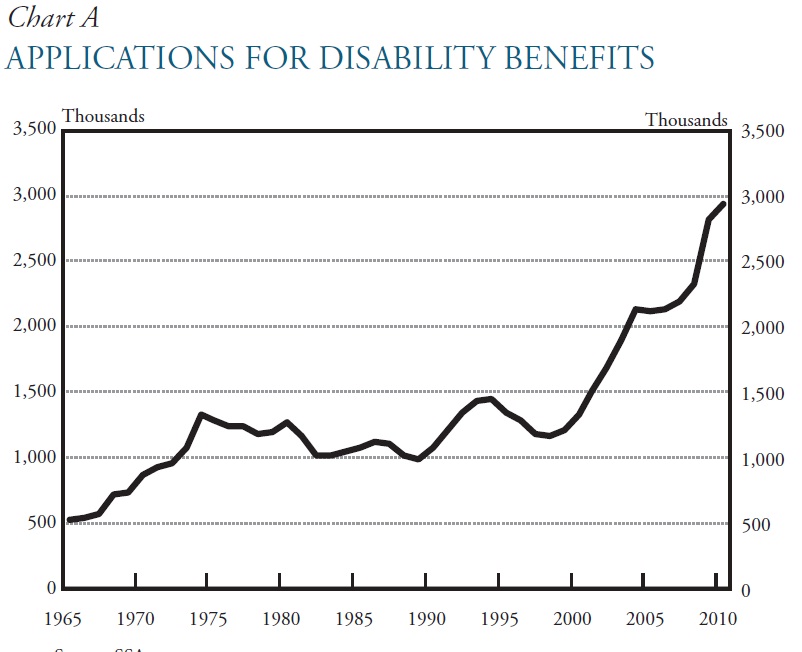
The other theory I've heard is that we're seeing more people hop over to disability, but that trend does not seem to be accelerating with the bad economy, but rather part of a longer-term trend that was halted for a short time during the best years of the 2000s:
If anything, this seems to be driven a lot by jobless youths and, surprisingly to me, people falling off the official labor force rolls. Conventional wisdom doesn't seem to be the thing here, and I can't come up with any other credible reason to explain this one.
I'm wary to use this outright as a political bludgeon - as bad as Obama's been for the economy overall, I can't really point to anything specific that he's done to decrease labor force participation even if his policies are negatively impacting the actual job market. At the same time, though, we're seeing these numbers touted as evidence of a recovery and of the government policies working when, in reality, the employment numbers, had things remained stagnant on a participation level (never mind increased), are quite possibly worse than they were during the peak of this economic crisis.
So I'm not sure what to make of it. I definitely believe this is an underexplored piece that's not getting a lot of traction, especially in the wake of the continued celebration about the lowering unemployment rate, but I am wary of the play of this when there may be better explanations to go along with it.
I do say was, however, because I'm no longer 100% sure I'm correct on this issue. So I'm sharing it with the group for a discussion.
As it stands, in terms of labor force discussion, we are significantly lower than we have been in some time, a 30 year low:
The "labor force," as it's defined, is people who are laid off and are actively searching for a job. In the most recent unemployment numbers, we added a net of 115k jobs in the US and saw the unemployment rate drop to 8.1%. The drop to 8.1%, however, was not facilitated by the jobs we added, but rather the 342k people who fell off of the labor force rolls. According to some estimates, if labor force participation was at its peak, unemployment would be approximately 11%.
So what's driving this? One theory has been old folks and boomers retiring earlier than they may have otherwise. The numbers do not bear that out, though:
The other theory I've heard is that we're seeing more people hop over to disability, but that trend does not seem to be accelerating with the bad economy, but rather part of a longer-term trend that was halted for a short time during the best years of the 2000s:
If anything, this seems to be driven a lot by jobless youths and, surprisingly to me, people falling off the official labor force rolls. Conventional wisdom doesn't seem to be the thing here, and I can't come up with any other credible reason to explain this one.
I'm wary to use this outright as a political bludgeon - as bad as Obama's been for the economy overall, I can't really point to anything specific that he's done to decrease labor force participation even if his policies are negatively impacting the actual job market. At the same time, though, we're seeing these numbers touted as evidence of a recovery and of the government policies working when, in reality, the employment numbers, had things remained stagnant on a participation level (never mind increased), are quite possibly worse than they were during the peak of this economic crisis.
So I'm not sure what to make of it. I definitely believe this is an underexplored piece that's not getting a lot of traction, especially in the wake of the continued celebration about the lowering unemployment rate, but I am wary of the play of this when there may be better explanations to go along with it.


(no subject)
Date: 7/5/12 21:37 (UTC)(no subject)
Date: 7/5/12 22:04 (UTC)WAT
(no subject)
Date: 7/5/12 22:08 (UTC)(no subject)
Date: 7/5/12 22:11 (UTC)(no subject)
Date: 7/5/12 22:14 (UTC)(no subject)
From:(no subject)
From:(no subject)
From:(no subject)
From:(no subject)
From:(no subject)
From:(no subject)
From:(no subject)
From:(no subject)
From:(no subject)
From:(no subject)
From:(no subject)
From:(no subject)
From:(no subject)
From:(no subject)
From:(no subject)
From:(no subject)
From:(no subject)
From:(no subject)
From:(no subject)
From:(no subject)
Date: 7/5/12 22:30 (UTC)Your articles that you say don't bear out those numbers actually say that they do. If you want to know more the Kansas City article below does an excellent job covering all the bases without getting overly technical.
I'm wary to use this outright as a political bludgeon - as bad as Obama's been for the economy overall, I can't really point to anything specific that he's done to decrease labor force participation even if his policies are negatively impacting the actual job market. At the same time, though, we're seeing these numbers touted as evidence of a recovery and of the government policies working when, in reality, the employment numbers, had things remained stagnant on a participation level (never mind increased), are quite possibly worse than they were during the peak of this economic crisis.
This is a doozy of a statement statement. Firstly, ignoring your take on Obama, if Obama were to directly damage the labor market it would effect participation rates. Secondly, participation rates have been declining for a decade and trends suggest that they will continue into this one. Thirdly, in no way are things worse in the job market right now than they were at the height of the recession. Not even close.
As for the 11% claim:
If the participation rate were at its trend, the unemployment rate would
have averaged 10.7 percent in 2010, compared with the actual average
of 9.6 percent. In 2011, unemployment would have averaged 10.0 percent rather than its actual 8.9 percent
http://kansascityfed.org/Publicat/EconRev/PDF/12q1VanZandweghe.pdf
So I'm not sure what to make of it. I definitely believe this is an underexplored piece that's not getting a lot of traction, especially in the wake of the continued celebration about the lowering unemployment rate, but I am wary of the play of this when there may be better explanations to go along with it.
Every economist I know of is concerned with LFPR. I don't get what you are talking about.
None of this is to say the nation's labor force is in great shape, but rather to point out the politically neutral reality of a situation with roots going back to the late 90s.
More food for thought.
http://chicagofed.org/digital_assets/publications/chicago_fed_letter/2012/cflmarch2012_296.pdf
(no subject)
Date: 7/5/12 22:52 (UTC)Are we looking at two different statistics? I only ask because the numbers seem to imply no reduction in employment for those who would be part of those aged demographics.
Secondly, participation rates have been declining for a decade and trends suggest that they will continue into this one.
A fair point that I definitely missed.
Every economist I know of is concerned with LFPR. I don't get what you are talking about
I guess that's more a reference to the punditry than the economists. I hear a lot about it on my econ blogs, for sure.
Thanks for the reading material, though - exactly what I was looking for. I'll dig in shortly.
(no subject)
Date: 7/5/12 23:00 (UTC)I was going off the Kansas City's report. They used a couple different models and concluded that demographic trends account for roughly half of the dip.
I guess that's more a reference to the punditry than the economists. I hear a lot about it on my econ blogs, for sure.
I'm definitely a biased source, I just finished my labor econ final a couple of hours ago. Honestly, I doubt I can continue much more on this discussion. My brain is done and finals are just getting started.
(no subject)
From:(no subject)
From:(no subject)
From:(no subject)
From:(no subject)
From:(no subject)
From:(no subject)
From:(no subject)
From:(no subject)
From:(no subject)
From:(no subject)
From:(no subject)
From:(no subject)
From:(no subject)
Date: 7/5/12 23:38 (UTC)(no subject)
Date: 7/5/12 22:31 (UTC)Increase in kids going to school, decrease in working during high school/college. High unemployment rate for the 16-25 set is only a problem if they're idle.
Still a demographic factor.
Private market is legitimately doing well right now, with the low jobs numbers being entirely the fault of declining government jobs (go go austerity!). If decline in labor participation rate was actually due to a discouraged workforce, we'd be seeing a rise in unemployment right now. We're not.
(no subject)
Date: 8/5/12 01:53 (UTC)(no subject)
Date: 7/5/12 23:11 (UTC)(no subject)
Date: 7/5/12 23:23 (UTC)I heard a discussion the other (prly on conservative talk radio, for what it's worth) that there is a whole new "cottage industry" for getting psychological disability. (came to think of it I may have heard it on a "lawyer" show I listen to) I'd really like to see statistics on it.
(no subject)
Date: 8/5/12 01:21 (UTC)(no subject)
From:(no subject)
Date: 8/5/12 02:26 (UTC)Our disability system is fucked. But it's fucked for particularly understandable institutional reasons.
SDI is a safety net of last resort. It should be very difficult to qualify. But the average person isn't going to have the required sophistication to jump through the various bureaucratic and medical hoops required. As a result, most people are turned down the first time. And while these people wouldn't usually have the resources for legal help, the lump sum of back-benefits creates a financial incentive for lawyers to step in and help.
So there's an incentive for lawyers to qualify people who don't qualify, which will raise the bar, meaning the average person is less likely to qualify on their own, leaving a lot of people paranoid about the government waste and legitimately needy people in the cold.
Additionally, it's draconian. Many people who legitimately cannot support themselves with their disability can still contribute to the economy in some small, intermittent ways. But if they do, that's used as evidence that they don't have a disability. So once people realize they need SDI, they are encouraged to drop out of the work-force completely.
With mental health, it's especially difficult. But that's mostly because mental health is difficult. Both to diagnose and to treat. Compliance is difficult given the nature of mental health, and even given perfect compliance, relapse can typically be a given. Medically, we struggle with it. Creating a safety net that handles it well is a hell of a thing to ask. But given that mental illness is highly correlated with poverty, any sort of safety net will have to struggle with how to handle mental illness. I am not trying to say that poor people are crazy. But when you're crazy, it's hard to be successful.
Hopefully, we'll figure out a way to deal with it in a better manner. Our society, and the resulting policy, treats mental illness as a loss of personhood. If you say you're crazy, people will try to convince you you're not. Because when you convince them you are, they take aggressive attempts to control you. You can escape prison sentences, but only by turning yourself over to the care of licensed doctors who will always have power over you. If you choose to seek out disability assistance, you can never seek work during your relapses without being accused of faking it. Your loved ones can go to court and actually take possession of your life so you cannot make your own choices.
I say this as someone diagnosed with anxiety and ADHD, with loved ones diagnosed with all sorts of crazy. We mean well and we try hard. But right now it's the wild wild west. So while there's a grain of truth to the conservative scare story, I hope people realize how much more there is to the story.
(no subject)
From:(no subject)
From:(no subject)
From:(no subject)
Date: 8/5/12 15:47 (UTC)(no subject)
From:(no subject)
From:(no subject)
Date: 7/5/12 23:29 (UTC)(no subject)
Date: 7/5/12 23:57 (UTC)1) The economy got bother in spite of Obama's policies!
2) The economy got worse because of Obama's policies!
There are no other possibilities. Personally, I believe the President has little power over the economy one way or the other. Tax policy has little to do with booms and busts, and I fully accept that the boom during the Clinton years was due to an explosion by the technological sector and digitization of the service industry.
(no subject)
Date: 8/5/12 02:38 (UTC)You entered this comment from Siri with your iPhone. didn't you? Or possibly your spillchucker changed better to bother on your phone.
(no subject)
Date: 8/5/12 03:45 (UTC)(no subject)
Date: 8/5/12 06:42 (UTC)But I agree Gov't has no real power for manipulating the broad economic trends... at least not on purpose.
(no subject)
Date: 8/5/12 08:31 (UTC)Do you even proof your posts?
(no subject)
Date: 8/5/12 16:24 (UTC)(no subject)
Date: 8/5/12 19:37 (UTC)(no subject)
Date: 10/5/12 08:15 (UTC)