![[personal profile]](https://www.dreamwidth.org/img/silk/identity/user.png) airiefairie posting in
airiefairie posting in ![[community profile]](https://www.dreamwidth.org/img/silk/identity/community.png) talkpolitics
talkpolitics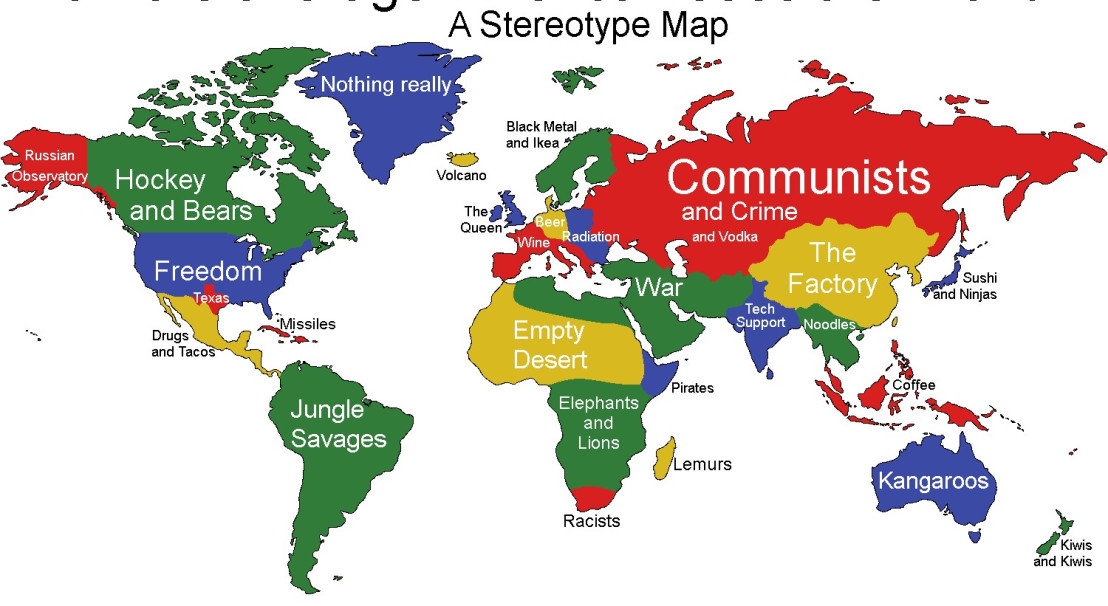
When you are living within another culture, it is easy to become a victim of stereotypes. People will generally hold beliefs of other groups of people that are always untrue and in most cases they will start judging you for your racial marks.
As foreigners, we need to understand that making stereotypes is not a natural phenomenon in human beings. Instead, stereotypes are reinforced through dominant groups in society, in order to favour racial groups over others.
However, people that make these judgements need to understand that there is no scientific evidence that any race is superior to another. After all, every culture has criminals and geniuses. Also, they need to understand that the idea that any race is pure does not exist.
Compared to years ago humanity has made some progress accepting multiple cultures in one society; nonetheless, we need to do more as individuals: leave aside the differences, stop basing our perspective of others on racial profiles and start viewing those around us based on their personal qualities and achievements.
Sounds simple? Sadly, turns out that it isn't.


(no subject)
Date: 16/7/21 19:42 (UTC)*looks at the large numbers of people seeking erasure of all of that complexity and wants to throw up*
(no subject)
Date: 16/7/21 19:49 (UTC)(no subject)
Date: 16/7/21 23:11 (UTC)(no subject)
Date: 17/7/21 02:33 (UTC)(no subject)
Date: 17/7/21 11:04 (UTC)(no subject)
Date: 20/7/21 09:18 (UTC)Modern example:
The defining trait of the group "people in Saudi Arabia" is their location, not their appearance. But is it racism to say that people in Saudi Arabia are highly religious? They sure are tolerant of theocracy there, though I bet if they were more connected to the outside world and less dependent on welfare from kings, they would rise up. If I meet someone from Saudi Arabia I am fully prepared to assume they pray to Allah five times a day. Racism? Or clarity?
Historical example:
Is it racism to say that the Vikings that inhabited Iceland for hundreds of years were: Socially conservative, environmentally destructive, and relatively violent in their settling of disputes? Or is it clarity? Written accounts all over Europe and from within Viking society, as well as clear evidence that Iceland was divested of 97 percent of its trees after they arrived, would point towards clarity. Their history is loaded with warring chiefs and raids, and only settled down after they decided to swear allegiance to a foreign king and take up Christianity, and basically stopped being Vikings.
Back in the day, everyone considered "race" and "geographical origin" interchangeable. And for understandable reasons, what with how limited travel was. In modern times we've driven a wedge between these things and started to whittle down the importance of "race" as a carrier of behavior and value. But there is still so much progress to make, clearly, because people with the same geographical origin but a different appearance are still treated very differently, within their own communities as well as beyond.
And, to work against stereotypes you sometimes need to know in detail what they are. But by deciding to work against them, you are also in a very real way acting upon them. If I meet a black man on the street in Oakland, I bring to bear a decades-long and complicated accumulation of assumptions about how that man perceives me, how other people who look like me have treated him, and how I can present myself so as to show I am not bound by those assumptions and will treat him with dignity and camaraderie. Am I engaging in racist behavior? Would it be better for both of us if I was completely unaware of any stereotypes held by society at large, like my young nephews generally are? A little bit yes, a little bit no. It's very likely I can be more helpful to that man by knowing what we're working against. Damn right it's complicated.
So, I think we need to be specific. Stereotypes can be useful. But the stereotypes we want to fight in modern society are specifically the negative ones based on appearance alone, and second to that the negative ones based on place of origin. Though, like in the examples above, they can still contain truth.
Also, I don't think it's a matter of "accepting multiple cultures in one society". That's another way of saying "everyone stays in their assigned seating and doesn't get to make judgements or change." It's a matter of actively sorting out the differences that matter from the ones that don't, which requires a collective agreement on the importance of principles over customs, and a certain lack of possessiveness about one's own cultural identity. And damn right it's complicated, because people use external signifiers - like clothing, prayers, gestures, phrases, ceremonies of all kinds - to advertise and reinforce what they believe in, and those things are easily misinterpreted. Like the abaya for example. Or a prominently worn cross. Or saying "God bless you" to an atheist.
This is interesting to me because I suspect that people around my own political spectrum - left-leaning liberals in California - don't actually want multiple cultures coexisting. What they want, is one unified culture that embraces liberal principals, but also displays all the outward trappings of cultures from all over the world. In other words, people wearing abayas and carrying prayer mats, happily standing shoulder-to-shoulder with people wearing long pants and kippot, right next to people wearing gold glitter mankinis and shouting "yas queeen!", with no sense of discomfort or silent judgement between them, but also no desire to blend, for fear of losing their identity or values. (Which is very hypocritical if you think about it.)
If I am a guest in a Christian household and they take me to church on Sunday, and the morning sermon contains a dozen references to how misguided and shameful homosexuals are (true story), what is the better move? Stand up and walk out, embarrassing the members of the household that are hosting me, but making a powerful example to the congregation that people who would object to this treatment are in their very midst? Or sit there and say nothing, because I am a guest and must be tolerant of their religious ways? Because I must be accepting of their culture?
Conversely, to a Christian, is the solution to this dilemma, "we will live among these homosexuals even though we know they are sinful and gross, because slaughtering them would be worse?" That does not strike me as progress, but rather a dead-end.