![[personal profile]](https://www.dreamwidth.org/img/silk/identity/user.png) abomvubuso posting in
abomvubuso posting in ![[community profile]](https://www.dreamwidth.org/img/silk/identity/community.png) talkpolitics
talkpolitics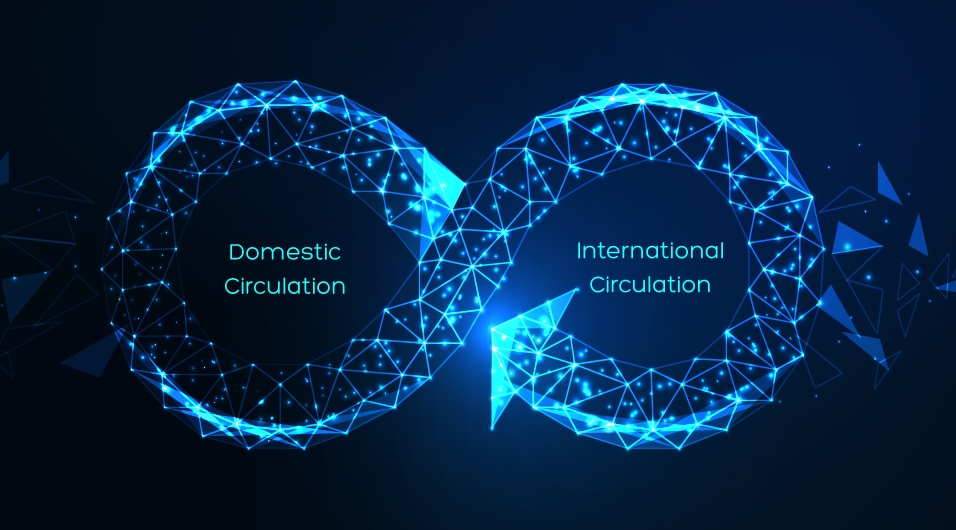
Given the Covid pandemic, the overall suspicion about tech giants like Huawei, the US trade pressure, and increasing defensiveness from the EU, China is beginning to realise its exports-driven growth is becoming a weakness. So it's understandable that their new 5-year plan is now focusing more on the domestic market.
This isn't the first time that we've heard of China's need to re-orient its economic model towards one dominated by domestic consumption. But now the context is different: increasing hostility from the US and Europe. This means China will finally have to get real about limiting its dependence on exports.
Trump's sanctions have left China with no other option but double its efforts to tie economic growth to domestic consumption and support for local innovation so it could maintain and expand its global positions. So it's no surprise that Xi Jinping recently announced a new long-term model that he called Dual Circulation. The goal is to get a production cycle that would be independent of foreign technology, investment and exports markets. China will be trying to establish a sustained circulation of goods that are entirely produced and consumed within the country. Of course, Xi also said the domestic circulation would be complimented with international circulation.
Three decades ago, Deng Xiaoping introduced the Great International Circulation plan, but the 2008/9 crisis showed the vulnerabilities of an exports-driven model, and made the Chinese leaders try to re-direct growth through domestic engines. China realises that the big success of the great international circulation has also generated serious problems. In 2006, when China was contemplating its 5-year plan, their reports concluded that their growth should mostly be based on domestic demand, especially consumer demand. The engine of economic growth was supposed to be re-oriented from an investment- and exports-driven growth to one that balances internal and external demand and investment.
In essence, the Dual Circulation concept is a strategy for reinforcing the Chinese economic stability at the background of global economic turmoil and the overall withdrawal of Western democracies from globalisation, in this case China viewing the plan as its way of protecting itself from economic exposure to outside factors. This will make China more focused on itself, and more obsessed with sustainable development rather than growth for its own sake.
China has made such efforts in the past, granted. But those occasions were more like a short-term reaction to crises, driven by the idea that some extra effort would help them go through the difficult moment by injecting stimulus into the economy, and overcome the symptoms. While this new model, at least in theory, is now meant to be permanent, and address the core of the illness.
The economic subject was central to last month's 5-year plan proceedings, particularly in the context of the Covid pandemic. It's true that we've heard talks and plans of re-directing Chinese development before, but the truth is, it takes a lot of time and effort to really do such a thing - China is not a small country, after all.
The sheer scales of this undertaking would require massive reform, which the Chinese rulers don't seem willing to contemplate at this point. But reform has to happen, and sooner rather than later - including granting more space and opportunity for developing start-ups and other private enterprises, curbing the power of state giants, breaking up state monopolies, and doing agrarian reforms that would allow rural people to generate new and more efficient forms of agricultural production.
The IMF has updated its outlook for the Chinese economic growth up to 1.9% for 2020. In the meantime though, the recovery of consumption still lags behind production levels, and there's consistent loss of jobs, and an overall economic uncertainty due to the ongoing pandemic. Increasing domestic consumption requires increasing incomes, and this means China needs huge structural reforms.
Although average income in China has grown 8-fold between 1978 and 2015, inequality remains high. Recent research shows the share of the national income going to the top 10% has grown from 27% in 1978 to 41% in 2015, while that of the bottom 50% has dropped from 27% to 15%. Another issue is that due to the lack of safety nets (like adequate pensions, and proper health care), the Chinese people largely prefer to put money aside rather than invest. Gross domestic savings peaked in 2008, reaching as high as 53% of the GDP. That was right before the financial crisis struck. But even now they're consistently hovering around 45%. Meanwhile, private consumption makes up 38.8% of the GDP, compared to 51.7% in the EU and 66.8% in the US. Besides, the Chinese aged 20-30 were born in the One Child era, and they now have to take care of two parents after their retirement, as well as their own children (which are no longer just one), and this in a fiercely competitive job market.
The Dual Circulation strategy now being part of the next 5-year plan, the next big step should be pro-market reform. That's the factor that would provide the true potential for growth. And we're not even talking the legendary two-digit growth from past years. Rather, a more modest 3-4% growth for the next 5 years.
Sure, Xi's plan got met with a huge media euphoria. The Chinese state outlets are calling it a new direction for development, where domestic and international markets would stimulate each other. The president has said China should snatch the initiative for change, and create new opportunities for overcoming the current challenges. While that sounds all nice and dandy, he's still got a lot of work ahead of himself, and he's yet to do the most important steps along the way.


