![[identity profile]](https://www.dreamwidth.org/img/silk/identity/openid.png) abomvubuso.livejournal.com posting in
abomvubuso.livejournal.com posting in ![[community profile]](https://www.dreamwidth.org/img/silk/identity/community.png) talkpolitics
talkpoliticsI like the idea of playing a relevant vid just for atmosphere while reading something, so here:
http://www.youtube.com/watch?v=pEK-a2HpdZ8
80 years have passed since the last time Nelson Mandela, the first black president of South Africa, visited school in his home town Qunu in the Eastern Cape. But even a brief look tells you that the place hasn't changed much since then. Smooth green hills rolling around the countryside, the occasional village house, most of them really shacks, painted in the traditional Xhosa colours, blue and yellow. Indoors - always a similar interior. The beds are lifted a bit from the ground, so that the night ghosts won't get you while you're sleeping. I'm sure the hosts meant the cold air that tends to drift just above the floor, but I wasn't willing to argue. Far to the west, the imposing peaks of the Dragon Mountains are hanging over lush pastures. That's the border with Lesotho, the mountain kingdom. It's like a world taken from a JRRT story, except this one is real. And I was fortunate to see it a month ago during a trip in the countryside.

Nothing suggests Qunu to be a place of pilgrimage. The only modern flat building in town is Mandela's museum. It sits lonely in the center of the village. A lady in green uniform sits there yawning, waiting in vain for someone to show interest in the presentation about Mandela's biography that she has learned by heart.
Until recently, the locals were having big dreams about hordes of visitors, new jobs, and good income. But today, most of them still keep living off of stock-breeding and whatever they can grow in their gardens: mostly spinach, cabbages and bananas.. At least their relatives who've moved to the big modern cities (Johannesburg, Cape Town, Durban) still haven't forgotten them. The Eastern Cape is perhaps the poorest province in South Africa. Electricity only arrived there in the late 90s. No ANC government has ever cared about that corner of the country: no bonuses, no stimulus programs, no nothing. Even despite the fact that it's Mandela's birthplace, and practically the cradle of the ruling ANC party itself.
But there could be an upside to that if we looked from a certain angle. Say, you'd like to sense the real soul and heart of South Africa. Well then, you'll have to turn your back to the neat beaches of kwaZulu-Natal with the silvery sands, and the lush Garden Route in the Western Cape with its Mediterranean feel and all the vineyards and orchards, or the world-famous wildlife reserves in the northern part of the country with all the beasts (Big Five) and the safari tours. No, instead you'll have to take a closer look at the eastern corner of the country, that rugged land lying between the Dragon Mountains and the Indian Ocean. Looks rather faceless on the map, right? But actually it's far more "real" than anything you'd see in South Africa. Sure, there are no big cats and no elephants on the roads... "Just a village in a green valley, cut by clear rivers", as South Africa's most famed son, "Madiba" once said.
The Eastern Cape is like a landscape that only one great painter could draw, and (s)he's definitely not a mortal. Lonely inlets rush inland in spectacular ways, dramatic rocks meet the high roaring tides... The coast between East London and Port Edward bears the name Wild Coast for a reason. And behind the shore? Endless chains of grassy hills, steep roads wreathing across the narrow gorges, and tribal houses dotting the heights. Nguni cows roam the pastures, alongside sheep and goats. And total poverty reigns everywhere.


For a long time this was a God-forgotten place. During apartheid, the regime established the pseudo-state called Transkei (meaning it was beyond the river Kei). It was a state recognised only by South Africa. It was one of the many "homelands" (or bantustans) the regime had assigned for its black population. While the whites were occupying the most fertile regions and holding all economic power in their hands, the indigenous peoples were being crammed into the most inaccessible corners, only partially matching their ancestral lands. Most of these bantustans were in the northern, eastern and south-eastern part of the country, with no connection between themselves: Transkei, Ciskei, kwaZulu, Bophuthatswana, Qwaqwa, Venda, Gazankulu, Lebowa... Millions of black people were forcefully relocated and squeezed into a small territory: although they were 80% of the population, they now had just 13% of the land, and the worst one, at that. The ostensible independence of these reservations was just propagada that was so transparent that no country apart from South Africa ever recognised their independence. But they're still the places where one could truly see the authentic identity of black South Africa today.

And maybe it's exactly the beauty of this region that's a guarantee for a better future. For several decades, Transkei was practically economically independent from South Africa, it was self-sufficient, isolated. The coast has preserved its ancient beauty which now attracts hundreds of adventurers and people with independent spirit and unconventional lifestyle, in the modern post-industrial context. I mean, how could one resist the charm of those pristine beaches that look as if they've hardly been ever touched by a human foot? And the endless trek paths along the coast and further inland, leading to all sorts of surprising natural treasures, like unique endemic plants and animals, and breath-taking waterfalls, and tiny lakes that make you just sit there and never remove your gaze from them. Even in the middle of the southern African winter, the warm currents from the Indian Ocean guarantee a temperature of at least +20'C in the day. In the cool wintry mornings, the sea greets you with a warm bath, which you share with dolphins and whales - one could actually see their funny little fountains spraying above water while you're criss-crossing the waves with your boat. The air is so painfully fresh it causes your diaphragm to spasm.
The region looks totally forgotten by modernity, although it's still forced to cope with the challenges of modern South Africa. Around big occasions like Christmas and Easter, the roads are crowded with buses, full to the top (and often over the top) with Xhosa workers coming back from the big cities where they've moved to make a living. And if today the white South Africans are making an average of 7*x the money their black compatriots make, the black middle class is steadily swelling in terms of size and prosperity. Maybe not as fast as we might be hoping for, but still. BRIC has become BRICS for a good reason. One could now see lots of black yuppies in the respective financial "Cities" of Jozi, Durbs and the Mother City, and that's no surprise any more. They're called "black diamonds" here. But that said, a huge majority of the black population still barely makes ends meet, doing the most demanding jobs like construction workers, cleaners, night guards, factory workers, nannies, and miners.
Lots of people from the Eastern Cape (in their majority of the Xhosa variety) now live a miserable life in the townships of Jo'burg (the famous SoWeTo) and here in Cape Town. There's actually a whole twin city next to CT now living its own life to the south of the older CT, it's called the Cape Flats. It has its own dynamics, its own rules of life, its own architecture and of course, its own politics. For example the ANC, in their attempt to break the monopoly of the DA party in ruling the city and the Western Cape province and being a thorn in ANC's ass for years (due to the unique demographic structure of the population here, which is mostly Afrikaans-speaking, coloured + white population), has gone to tremendous lengths in re-drawing the election map of the region, moving vast black populations from the Eastern Cape and Gauteng into the Cape Town suburbs, hoping to win elections that way. But that's happened at the expense of creating serious social problems, problems of housing, jobs, and health care, which I suspect will one day come back to bite the rulers on the ass.

So, those Eastern Cape workers now living in Cape Town, work temporary jobs here, living off of miserable income, and they still send a great chunk of it to their relatives, kids and parents back in the E.Cape. Once or twice during the year they manage to afford a group trip, crammed in these old buses, returning to their villages to meet their families, bags loaded with presents, and with heavy hearts from the imminent parting that's sure to come in just a few days. They're the Gastarbeiter of the new time.
The legacy of apartheid is still hanging heavy on the neck of the Eastern Cape, particularly Transkei. Almost every hill in the interior, with or without water, is populated, narrow roads have been built, and people are doing heavy work trying to grow their food and find pastures for their livestock. The "homelands" policy attempted to re-locate lots of people into these infertile lands, but at some point they ran out of land and opportunity. The soil has been beyond exhausted. Erosion due to over-exploitation, is a serious problem. Every year thousands of tons of soil go into the ocean.


That's why the local authorities are investing lots of hopes in touristm. Mandela's museum in Qunu and the bigger one in the region's capital uMthatha are expected to unravel the history of the countryside in front of the visitor. Because it's where not only Mandela grew up, but also Thabo Mbeki, the second president of free South Africa. And Walter Sisulu, one of the great fighters against apartheid. Sisulu and Mandela spent 25 years together in the prison on Robben island, just outside Cape Town. I imagine the feeling of seeing the mainland every single day for 27 years (in Mandela's case), and knowing it's so close and yet so far away. The Eastern Cape is indeed the cradle of the struggle, and the birthplace of ANC, the present political juggernaut that's ruled the country ever since 1994. It was here in Fort Hare where the first "black university" in South Africa was established (in 1916, in the old times before apartheid).
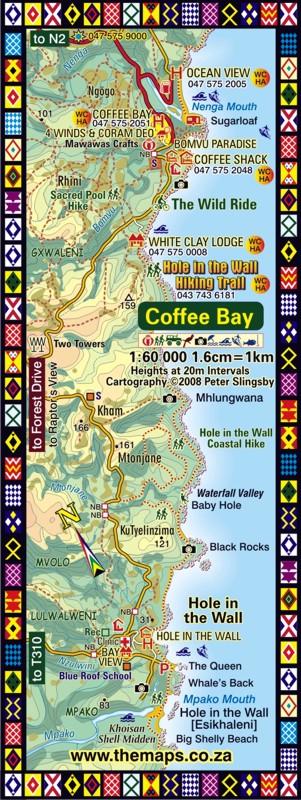
But for now, the expectations haven't been met. There are no huge crowds of tourists flocking to the region. It's become the gathering place for adventurers, lovers of wild nature, and loners. But not wealthy tourists. The most frequent sight are the surfers, because these shores can boast of the most awesome waves in the whole African continent. Like Coffee Bay for example.
Coffee Bay is a small village of some 1000 people, most of them Xhosa, just like Nelson Mandela (and like three of my kids). There are also about 50 whites in Coffee Bay: mostly hippies, dreamers, fans of simple life in the nature, downshifters seeking escape from the crazy life in the big cities, and a pressure-free lifestyle. Apparently they're planning to live for 100 years in total harmony with nature. At least that's what one or two of them shared with me. "Molweni nonke!" (Howzit!), every single surfer greeted me on the way to the beach. Everyone greets everybody else like a brother.
Coffee Bay got its name after an incident in the 19th century when a cargo ship full of coffee sank near that shore. The legend goes that a bunch of coffee bushes then grew up along the coast, but I couldn't see any coffee bushes. But there are plenty of aloe forests with their huge blossoms and heavy pulpy leaves. Above them, the hills with the round Xhosa shacks shining in flashy green, blue and yellow. This is the real Africa, not the one on the beaten track in the east, the tamed one with the special roads and fenced wildlife reserves. Or the cultivated French-Riviera-looking coastline in the south-west.


However, the tourists seldom leave the comfort of the N2 national highway, to have a detour and cast a glimpse on the many inlets along the coast. I did stay for a night at Kei Mouth, and it was splendid. But it wasn't easy to access. The politicians claim they want to build a new highway that runs closer to the coast, hoping it'll stimulate many industries and bring more tourists, and hence open new jobs. Looking for more prosperity sounds good. But on the other hand, exactly how much development and progress could an idyll like this bear, until it breaks down and gets transformed into yet another Durban coast, or a Cape Flats sort of area? Would the guests still want to come when most inlets get lined up with luxurious holiday complexes, like the one that my firm is currently finishing a bit further west, on the border between W.Cape and E.Cape? I doubt they'd call it the Wild Coast any more if that happens...
But at least for the time being, the hotels and hostels can be counted on your fingers. Human presence goes only as far as the green garden hedges covered in all colours of the rainbow, and the trees ornated with bright pieces of cloth and hand-made amulets for peace and good luck. Jubilant Xhosa kids chase the soccer ball on the dusty streets that've never seen asphalt. Whoever wants, could drum a little bongo at the place of the former real-estate broker, now turned rastafari slacker. Or get in contact with the "Universe" with the help of a local yoga instructor / masseur who heals with volcanic "energy stones". There's even a new kindergarten for the kids of those who've decided to move here permanently, having found peace at long last.


The presumably modern laissez-faire lifestyle has been part of South Africa's history for ages. For instance in Port St. Johns, just a few inlets further north from Coffee Bay, fresh fish locales substitute the Pizza Hut and McDo, and there are small hostels at decent prices. Similarly to Coffee Bay, Pt. St. Johns is also teaming with outsiders, escapists, survivalists, downshifters and hippies. The smell of marijuana is often felt in the air. In the 80s, lots of young lads hid in these areas to escape military conscription. Transkei is a sort of West Berlin, many of those who moved there wanted to avoid the army at any cost (coast?) After the fall of apartheid, many of them chose to remain there, never to return to their homes. This is their new home. Because "Jou tuiste is waar jou hart is", as a popular SA band Die Heuwels Fantasties sings (it means "Your home is where your heart is", I like this motto very much). Those folks who live there look very much the way they looked back then in the 80s, only their long hairs are grey now.
But the true beauty lies inland. The region behind Pt. St. Johns looks like the Treasure island. Truly. The Magwa Falls falling from a 100 m height on the steep plateau, promises to become a major sight of interest.


But for now, very few people from around the country know this place even exists, let alone those from outside the country. It's still untouched, a virgin corner of this vast and diverse land. The only visitors are the local Xhosa women with their traditional white paste covering their faces (it's not a ritual, I was told it's a natural sun protection), coming here to wash the laundry on the polished stones in the river with a water so sweet you can bottle it right away, and sell it in the superstores in the cities. Fine vapour rises above the gorge above the falls that's filled with the endless trills of strange birds; the sun is painting a fabulous tangle of tiny rainbows swirling overhead... An eagle is roaming with a distant scream around the edge of the waterfall. And to the south of all this bliss begins an endless jungle full of apes and Cape otters, and all sorts of antelopes (the many types of ~boks we know and love).
Perhaps underdevelopment could be turned into an advantage then? After all, even Hollywood sniffed the potential of this place and came to Port St. Johns to shoot Blood Diamond with DiCaprio. The abandoned airplane track had obviously enchanted the movie crew very much. The round houses of the Xhosa are perched around the hills nearby, puffing smoke through their chimneys. The only sound is of the whistling wind, carrying the eternal sound of the sea uphill. The gaze stretches as far as the green horizon, and wanders around the hills and back through time, seeing things as they've been decades, even centuries ago.
I hope this is also the sight that the future holds for this place.

http://www.youtube.com/watch?v=pEK-a2HpdZ8
80 years have passed since the last time Nelson Mandela, the first black president of South Africa, visited school in his home town Qunu in the Eastern Cape. But even a brief look tells you that the place hasn't changed much since then. Smooth green hills rolling around the countryside, the occasional village house, most of them really shacks, painted in the traditional Xhosa colours, blue and yellow. Indoors - always a similar interior. The beds are lifted a bit from the ground, so that the night ghosts won't get you while you're sleeping. I'm sure the hosts meant the cold air that tends to drift just above the floor, but I wasn't willing to argue. Far to the west, the imposing peaks of the Dragon Mountains are hanging over lush pastures. That's the border with Lesotho, the mountain kingdom. It's like a world taken from a JRRT story, except this one is real. And I was fortunate to see it a month ago during a trip in the countryside.

Nothing suggests Qunu to be a place of pilgrimage. The only modern flat building in town is Mandela's museum. It sits lonely in the center of the village. A lady in green uniform sits there yawning, waiting in vain for someone to show interest in the presentation about Mandela's biography that she has learned by heart.
Until recently, the locals were having big dreams about hordes of visitors, new jobs, and good income. But today, most of them still keep living off of stock-breeding and whatever they can grow in their gardens: mostly spinach, cabbages and bananas.. At least their relatives who've moved to the big modern cities (Johannesburg, Cape Town, Durban) still haven't forgotten them. The Eastern Cape is perhaps the poorest province in South Africa. Electricity only arrived there in the late 90s. No ANC government has ever cared about that corner of the country: no bonuses, no stimulus programs, no nothing. Even despite the fact that it's Mandela's birthplace, and practically the cradle of the ruling ANC party itself.
But there could be an upside to that if we looked from a certain angle. Say, you'd like to sense the real soul and heart of South Africa. Well then, you'll have to turn your back to the neat beaches of kwaZulu-Natal with the silvery sands, and the lush Garden Route in the Western Cape with its Mediterranean feel and all the vineyards and orchards, or the world-famous wildlife reserves in the northern part of the country with all the beasts (Big Five) and the safari tours. No, instead you'll have to take a closer look at the eastern corner of the country, that rugged land lying between the Dragon Mountains and the Indian Ocean. Looks rather faceless on the map, right? But actually it's far more "real" than anything you'd see in South Africa. Sure, there are no big cats and no elephants on the roads... "Just a village in a green valley, cut by clear rivers", as South Africa's most famed son, "Madiba" once said.
The Eastern Cape is like a landscape that only one great painter could draw, and (s)he's definitely not a mortal. Lonely inlets rush inland in spectacular ways, dramatic rocks meet the high roaring tides... The coast between East London and Port Edward bears the name Wild Coast for a reason. And behind the shore? Endless chains of grassy hills, steep roads wreathing across the narrow gorges, and tribal houses dotting the heights. Nguni cows roam the pastures, alongside sheep and goats. And total poverty reigns everywhere.
For a long time this was a God-forgotten place. During apartheid, the regime established the pseudo-state called Transkei (meaning it was beyond the river Kei). It was a state recognised only by South Africa. It was one of the many "homelands" (or bantustans) the regime had assigned for its black population. While the whites were occupying the most fertile regions and holding all economic power in their hands, the indigenous peoples were being crammed into the most inaccessible corners, only partially matching their ancestral lands. Most of these bantustans were in the northern, eastern and south-eastern part of the country, with no connection between themselves: Transkei, Ciskei, kwaZulu, Bophuthatswana, Qwaqwa, Venda, Gazankulu, Lebowa... Millions of black people were forcefully relocated and squeezed into a small territory: although they were 80% of the population, they now had just 13% of the land, and the worst one, at that. The ostensible independence of these reservations was just propagada that was so transparent that no country apart from South Africa ever recognised their independence. But they're still the places where one could truly see the authentic identity of black South Africa today.

And maybe it's exactly the beauty of this region that's a guarantee for a better future. For several decades, Transkei was practically economically independent from South Africa, it was self-sufficient, isolated. The coast has preserved its ancient beauty which now attracts hundreds of adventurers and people with independent spirit and unconventional lifestyle, in the modern post-industrial context. I mean, how could one resist the charm of those pristine beaches that look as if they've hardly been ever touched by a human foot? And the endless trek paths along the coast and further inland, leading to all sorts of surprising natural treasures, like unique endemic plants and animals, and breath-taking waterfalls, and tiny lakes that make you just sit there and never remove your gaze from them. Even in the middle of the southern African winter, the warm currents from the Indian Ocean guarantee a temperature of at least +20'C in the day. In the cool wintry mornings, the sea greets you with a warm bath, which you share with dolphins and whales - one could actually see their funny little fountains spraying above water while you're criss-crossing the waves with your boat. The air is so painfully fresh it causes your diaphragm to spasm.
The region looks totally forgotten by modernity, although it's still forced to cope with the challenges of modern South Africa. Around big occasions like Christmas and Easter, the roads are crowded with buses, full to the top (and often over the top) with Xhosa workers coming back from the big cities where they've moved to make a living. And if today the white South Africans are making an average of 7*x the money their black compatriots make, the black middle class is steadily swelling in terms of size and prosperity. Maybe not as fast as we might be hoping for, but still. BRIC has become BRICS for a good reason. One could now see lots of black yuppies in the respective financial "Cities" of Jozi, Durbs and the Mother City, and that's no surprise any more. They're called "black diamonds" here. But that said, a huge majority of the black population still barely makes ends meet, doing the most demanding jobs like construction workers, cleaners, night guards, factory workers, nannies, and miners.
Lots of people from the Eastern Cape (in their majority of the Xhosa variety) now live a miserable life in the townships of Jo'burg (the famous SoWeTo) and here in Cape Town. There's actually a whole twin city next to CT now living its own life to the south of the older CT, it's called the Cape Flats. It has its own dynamics, its own rules of life, its own architecture and of course, its own politics. For example the ANC, in their attempt to break the monopoly of the DA party in ruling the city and the Western Cape province and being a thorn in ANC's ass for years (due to the unique demographic structure of the population here, which is mostly Afrikaans-speaking, coloured + white population), has gone to tremendous lengths in re-drawing the election map of the region, moving vast black populations from the Eastern Cape and Gauteng into the Cape Town suburbs, hoping to win elections that way. But that's happened at the expense of creating serious social problems, problems of housing, jobs, and health care, which I suspect will one day come back to bite the rulers on the ass.

So, those Eastern Cape workers now living in Cape Town, work temporary jobs here, living off of miserable income, and they still send a great chunk of it to their relatives, kids and parents back in the E.Cape. Once or twice during the year they manage to afford a group trip, crammed in these old buses, returning to their villages to meet their families, bags loaded with presents, and with heavy hearts from the imminent parting that's sure to come in just a few days. They're the Gastarbeiter of the new time.
The legacy of apartheid is still hanging heavy on the neck of the Eastern Cape, particularly Transkei. Almost every hill in the interior, with or without water, is populated, narrow roads have been built, and people are doing heavy work trying to grow their food and find pastures for their livestock. The "homelands" policy attempted to re-locate lots of people into these infertile lands, but at some point they ran out of land and opportunity. The soil has been beyond exhausted. Erosion due to over-exploitation, is a serious problem. Every year thousands of tons of soil go into the ocean.
That's why the local authorities are investing lots of hopes in touristm. Mandela's museum in Qunu and the bigger one in the region's capital uMthatha are expected to unravel the history of the countryside in front of the visitor. Because it's where not only Mandela grew up, but also Thabo Mbeki, the second president of free South Africa. And Walter Sisulu, one of the great fighters against apartheid. Sisulu and Mandela spent 25 years together in the prison on Robben island, just outside Cape Town. I imagine the feeling of seeing the mainland every single day for 27 years (in Mandela's case), and knowing it's so close and yet so far away. The Eastern Cape is indeed the cradle of the struggle, and the birthplace of ANC, the present political juggernaut that's ruled the country ever since 1994. It was here in Fort Hare where the first "black university" in South Africa was established (in 1916, in the old times before apartheid).
But for now, the expectations haven't been met. There are no huge crowds of tourists flocking to the region. It's become the gathering place for adventurers, lovers of wild nature, and loners. But not wealthy tourists. The most frequent sight are the surfers, because these shores can boast of the most awesome waves in the whole African continent. Like Coffee Bay for example.
Coffee Bay is a small village of some 1000 people, most of them Xhosa, just like Nelson Mandela (and like three of my kids). There are also about 50 whites in Coffee Bay: mostly hippies, dreamers, fans of simple life in the nature, downshifters seeking escape from the crazy life in the big cities, and a pressure-free lifestyle. Apparently they're planning to live for 100 years in total harmony with nature. At least that's what one or two of them shared with me. "Molweni nonke!" (Howzit!), every single surfer greeted me on the way to the beach. Everyone greets everybody else like a brother.
Coffee Bay got its name after an incident in the 19th century when a cargo ship full of coffee sank near that shore. The legend goes that a bunch of coffee bushes then grew up along the coast, but I couldn't see any coffee bushes. But there are plenty of aloe forests with their huge blossoms and heavy pulpy leaves. Above them, the hills with the round Xhosa shacks shining in flashy green, blue and yellow. This is the real Africa, not the one on the beaten track in the east, the tamed one with the special roads and fenced wildlife reserves. Or the cultivated French-Riviera-looking coastline in the south-west.
However, the tourists seldom leave the comfort of the N2 national highway, to have a detour and cast a glimpse on the many inlets along the coast. I did stay for a night at Kei Mouth, and it was splendid. But it wasn't easy to access. The politicians claim they want to build a new highway that runs closer to the coast, hoping it'll stimulate many industries and bring more tourists, and hence open new jobs. Looking for more prosperity sounds good. But on the other hand, exactly how much development and progress could an idyll like this bear, until it breaks down and gets transformed into yet another Durban coast, or a Cape Flats sort of area? Would the guests still want to come when most inlets get lined up with luxurious holiday complexes, like the one that my firm is currently finishing a bit further west, on the border between W.Cape and E.Cape? I doubt they'd call it the Wild Coast any more if that happens...
But at least for the time being, the hotels and hostels can be counted on your fingers. Human presence goes only as far as the green garden hedges covered in all colours of the rainbow, and the trees ornated with bright pieces of cloth and hand-made amulets for peace and good luck. Jubilant Xhosa kids chase the soccer ball on the dusty streets that've never seen asphalt. Whoever wants, could drum a little bongo at the place of the former real-estate broker, now turned rastafari slacker. Or get in contact with the "Universe" with the help of a local yoga instructor / masseur who heals with volcanic "energy stones". There's even a new kindergarten for the kids of those who've decided to move here permanently, having found peace at long last.
The presumably modern laissez-faire lifestyle has been part of South Africa's history for ages. For instance in Port St. Johns, just a few inlets further north from Coffee Bay, fresh fish locales substitute the Pizza Hut and McDo, and there are small hostels at decent prices. Similarly to Coffee Bay, Pt. St. Johns is also teaming with outsiders, escapists, survivalists, downshifters and hippies. The smell of marijuana is often felt in the air. In the 80s, lots of young lads hid in these areas to escape military conscription. Transkei is a sort of West Berlin, many of those who moved there wanted to avoid the army at any cost (coast?) After the fall of apartheid, many of them chose to remain there, never to return to their homes. This is their new home. Because "Jou tuiste is waar jou hart is", as a popular SA band Die Heuwels Fantasties sings (it means "Your home is where your heart is", I like this motto very much). Those folks who live there look very much the way they looked back then in the 80s, only their long hairs are grey now.
But the true beauty lies inland. The region behind Pt. St. Johns looks like the Treasure island. Truly. The Magwa Falls falling from a 100 m height on the steep plateau, promises to become a major sight of interest.
But for now, very few people from around the country know this place even exists, let alone those from outside the country. It's still untouched, a virgin corner of this vast and diverse land. The only visitors are the local Xhosa women with their traditional white paste covering their faces (it's not a ritual, I was told it's a natural sun protection), coming here to wash the laundry on the polished stones in the river with a water so sweet you can bottle it right away, and sell it in the superstores in the cities. Fine vapour rises above the gorge above the falls that's filled with the endless trills of strange birds; the sun is painting a fabulous tangle of tiny rainbows swirling overhead... An eagle is roaming with a distant scream around the edge of the waterfall. And to the south of all this bliss begins an endless jungle full of apes and Cape otters, and all sorts of antelopes (the many types of ~boks we know and love).
Perhaps underdevelopment could be turned into an advantage then? After all, even Hollywood sniffed the potential of this place and came to Port St. Johns to shoot Blood Diamond with DiCaprio. The abandoned airplane track had obviously enchanted the movie crew very much. The round houses of the Xhosa are perched around the hills nearby, puffing smoke through their chimneys. The only sound is of the whistling wind, carrying the eternal sound of the sea uphill. The gaze stretches as far as the green horizon, and wanders around the hills and back through time, seeing things as they've been decades, even centuries ago.
I hope this is also the sight that the future holds for this place.


(no subject)
Date: 12/5/12 18:45 (UTC)Reading some more about these bantustans, I hereby withdraw my UN memorandum\ (http://t-p-nonsense.livejournal.com/68826.html).
(no subject)
Date: 13/5/12 09:48 (UTC)(no subject)
Date: 12/5/12 19:20 (UTC)(no subject)
Date: 12/5/12 21:45 (UTC)(no subject)
Date: 13/5/12 01:40 (UTC)(no subject)
Date: 13/5/12 09:50 (UTC)(no subject)
Date: 13/5/12 13:57 (UTC)(no subject)
Date: 13/5/12 08:18 (UTC)(no subject)
Date: 14/5/12 03:31 (UTC)